


Have you ever walked out of a meeting convinced everyone was aligned, only to realize later that half the room had concerns they never voiced?
A Harvard Business Review study found that the average leader retains just 25% of what they hear. Not because they’re distracted. Because they’re listening wrong. They’re waiting for their turn to talk, mentally drafting responses, scanning for flaws in the argument. That’s not active listening. That’s reloading.
The leaders who consistently make better decisions, build stronger teams, and avoid catastrophic blind spots aren’t the loudest voices in the room. They’re the best listeners. Here’s what they do differently.
1. They Listen for Problems, Not Confirmation
Most leaders walk into conversations with a position already formed. They’re not gathering information. They’re scanning for agreement.
When Howard Schultz returned to Starbucks as CEO in 2008, the company was closing 600 stores and bleeding cash. His board had a turnaround plan ready. Schultz ignored it. Instead, he flew to a Seattle store at 5 AM and asked a barista named Laura one question: “What’s broken?”
She didn’t hold back. Customers felt rushed. The new automatic espresso machines killed the ritual. The stores smelled like breakfast sandwiches instead of coffee. Schultz wrote everything down, asked follow-up questions for 45 minutes, and thanked her.
Within six months, Starbucks discontinued heated breakfast sandwiches, retrained 135,000 baristas in a single day (closing every store for three hours), and redesigned the espresso experience. Revenue recovered. The stock price tripled over three years.
Schultz didn’t listen to confirm his turnaround strategy. He listened to discover what actually needed fixing. That distinction matters more than any active listening technique you’ll find in a textbook.
Practical takeaway: Before your next important meeting, ask yourself: Am I going in to learn something, or to validate what I already believe? If it’s the second one, you’re not listening. You’re performing.
2. They Paraphrase Before They Respond
This is the simplest active listening technique that almost nobody actually uses.
Ray Dalio built Bridgewater Associates into the world’s largest hedge fund ($150 billion under management) on a principle he calls “radical transparency.” One of his non-negotiable meeting rules: before you respond to someone’s point, you must paraphrase it back to them. If they say you got it wrong, you try again until they confirm you understood.
It sounds tedious. It saves millions.
In a 2019 study published in the Journal of Experimental Social Psychology, researchers found that people who paraphrased their conversation partner’s statements before responding reached agreement 37% faster in negotiations. The reason is straightforward. Most workplace conflict doesn’t come from genuine disagreement. It comes from two people arguing about different things because neither one confirmed what the other actually said.
A typical exchange without paraphrasing: “We should delay the launch.” “We can’t delay, we’ll miss the window.” Now they’re debating timing when the real concern might be product quality, team readiness, or legal compliance. Nobody knows because nobody asked.
With paraphrasing: “We should delay the launch.” “So you’re saying the current timeline puts us at risk. Is it the product, the marketing, or something else?” Now you’re solving the right problem.
Practical takeaway: Start your next three responses in a meeting with “What I’m hearing is…” or “Let me make sure I understand.” It feels unnatural at first. Within a week, you’ll catch at least one major miscommunication you would have missed.
3. They Ask Questions That Prove They Were Paying Attention
Nothing kills trust faster than asking a question someone just answered. Nothing builds it faster than asking a question that shows you were tracking every word.
Indra Nooyi, former CEO of PepsiCo, had a framework she used in every strategy review. After a team presented, she would ask three specific types of questions, always in the same order:
First, a clarifying question. Not “can you explain that?” but something specific: “You mentioned distribution costs rose 12% in Q3. Was that across all regions or concentrated somewhere?”
Second, a stress-test question. “If Coca-Cola copies this strategy within six months, does our advantage hold?”
Third, a forward question. “What’s the first thing that breaks if we’re wrong about the consumer data?”
Her team at PepsiCo reported that these questions often surfaced risks that entire planning cycles had missed. Not because Nooyi was smarter than her strategy team. Because she listened closely enough to find the gaps they’d glossed over.
Compare this to the typical executive Q&A: “Great presentation. Any risks we should know about?” That question gets a predictable answer every time: “We’ve considered the risks and feel good about our position.” Useless.
Practical takeaway: After someone presents to you, ask one question that references a specific detail they mentioned. It proves you were listening and signals that details matter to you. People will start preparing differently.
4. They Create Space for What People Are Afraid to Say
Active listening isn’t just about processing words. It’s about reading what people are holding back.
When Mary Barra became CEO of General Motors in 2014, she inherited a crisis. Faulty ignition switches had been causing accidents for over a decade. Engineers knew. Middle managers knew. Nobody told leadership. The culture punished bad news, so people stopped delivering it.
Barra restructured how GM’s leadership listened. She replaced “any concerns?” (which always got silence) with pointed, specific questions: “What would you do differently if your name was personally attached to this decision?” and “If this goes wrong, what does the headline look like?”
She also instituted a practice she called “speak freely” segments in leadership meetings, where anyone could raise an issue with guaranteed immunity from blowback. Within the first year, GM’s internal safety reporting increased by over 200%.
A 2021 study from MIT Sloan found that psychological safety, the feeling that you can speak up without punishment, was the single strongest predictor of team performance. Stronger than talent, experience, or resources. And psychological safety starts with how leaders listen.
If people around you only share good news, you don’t have a communication problem. You have a listening problem. You’ve trained them, through subtle signals and reactions, to filter what they tell you.
Practical takeaway: In your next one-on-one, try saying: “What’s one thing about this project that you’d want me to know but might hesitate to say?” Then stay quiet. Count to five in your head. Resist the urge to fill the silence. What comes out in that pause is usually the most important thing you’ll hear all week.
5. They Eliminate Every Distraction, Not Just the Obvious Ones
You already know you shouldn’t check your phone while someone is talking. But active listening requires more than putting your device away.
Tim Cook runs Apple’s executive meetings with a rule that goes beyond “no phones.” If he catches someone mentally drifting, thinking about their next meeting, composing an email in their head, he’ll stop and ask them to summarize the last two minutes of discussion. If they can’t, the meeting pauses until they’re present.
This isn’t power tripping. It’s economics. Apple’s leadership team represents billions of dollars in decision-making capacity. Every minute of distracted listening in that room is a minute of degraded decisions that affect 160,000 employees.
Research from the University of Minnesota found that listeners who removed all distractions, visual, auditory, and mental, retained 77% of information compared to 10% for those who multitasked. That gap isn’t a rounding error. It’s the difference between a CEO who catches a critical supply chain risk in a briefing and one who learns about it from the Wall Street Journal.
The less obvious distractions are the dangerous ones. Thinking about what you’ll say next. Categorizing the speaker (do I agree or disagree?). Judging their delivery instead of processing their content. These invisible distractions do more damage than a vibrating phone because you don’t even notice them happening.
Practical takeaway: For one week, try this in every important conversation: focus entirely on understanding what the other person means. Don’t plan your response. Don’t evaluate. Don’t categorize. Just absorb. When they finish, take a full breath before you speak. You’ll be shocked at how much more you catch.
Why Active Listening Is a Leadership Multiplier
The benefits of active listening compound in ways that aren’t immediately obvious.
Satya Nadella spent his first 90 days as Microsoft’s CEO on what he called “listening tours,” visiting every division, asking one question: “What would you do if you were me?” He didn’t debate. He didn’t defend. He wrote things down and asked follow-ups.
What he learned reshaped Microsoft’s entire strategy. Teams told him the company was too internally competitive. That Windows was being prioritized over cloud. That the mobile strategy was burning cash with no path to relevance. Within two years, Nadella killed Windows Phone, restructured the company around Azure and cloud services, and shifted the culture from “know-it-all” to “learn-it-all.”
Microsoft’s market cap when Nadella took over: $300 billion. Today: over $3 trillion. The single decision that initiated that transformation was a decision to listen.
Active listening builds three things simultaneously: better information (you hear what others miss), deeper trust (people bring you truth instead of spin), and faster execution (less time fixing miscommunications, more time moving forward).
FAQ
What are the 7 key active listening skills?
The core active listening skills are: paying full attention, withholding judgment, paraphrasing, asking clarifying questions, summarizing, sharing observations, and being patient. In leadership contexts, the most impactful ones are paraphrasing, asking follow-up questions that reference specifics, and creating psychological safety for honest input.
Why is active listening important in leadership?
Leaders who listen actively make better decisions because they receive higher-quality information. When people feel heard, they share real concerns instead of filtered updates. A 2021 MIT Sloan study found that psychological safety, driven primarily by how leaders listen, was the strongest predictor of team performance across industries.
What is the difference between active and passive listening?
Passive listening is hearing words without engaging. Active listening involves deliberate focus, mental processing, and feedback signals like paraphrasing, asking questions, and acknowledging emotions. Passive listeners retain about 10% of information. Active listeners retain up to 77%, according to University of Minnesota research.
How can I improve my listening skills at work?
Start with three habits: paraphrase before responding (“What I’m hearing is…”), ask one follow-up question that references something specific the speaker said, and eliminate distractions during important conversations. These three changes alone will differentiate you from 90% of professionals.
What are examples of active listening techniques?
Effective techniques include: reflecting feelings (“It sounds like that frustrated you”), asking open-ended questions (“What would good look like?”), summarizing key points, using brief verbal affirmations (“I see,” “Go on”), and tolerating silence to let the speaker complete their thought. The best leaders combine these naturally rather than treating them as a checklist.
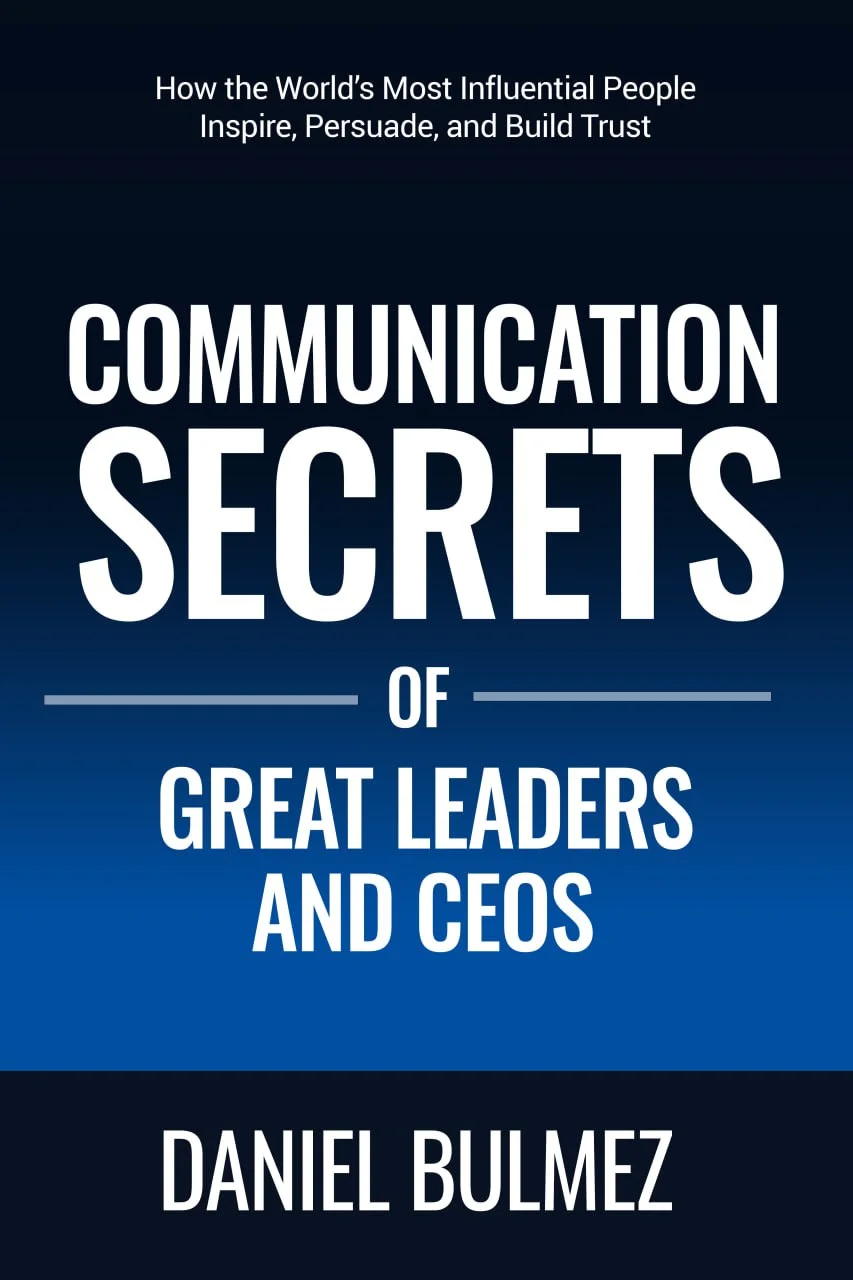
The patterns in this article scratch the surface. If you want the complete framework for how top leaders communicate, including the listening, speaking, and influence techniques that CEOs use behind closed doors, pick up a copy of Communication Secrets of Great Leaders and CEOs. It’s the deeper system behind everything you just read.
Daniel Bulmez is the author of Communication Secrets of Great Leaders and CEOs, available on Amazon.