


Why do some couples fight about the dishes every single week while others navigate career changes, money stress, and cross-country moves without ever raising their voices? It’s not love. It’s not compatibility. It’s communication patterns, and most people have never been taught good ones.
A 2023 study from the Gottman Institute tracked 3,000 couples over six years and found that the single strongest predictor of relationship satisfaction wasn’t shared interests, physical attraction, or even how often they fought. It was how they communicated during conflict. Couples who used specific, learnable communication patterns were 86% more likely to stay together and report high satisfaction.
Here are the seven lessons that separate couples who thrive from couples who slowly fall apart.
1. Say the Feeling, Not the Accusation
The fastest way to start a fight is to lead with “you always” or “you never.” The fastest way to actually be heard is to lead with what you feel.
Dr. Marshall Rosenberg, the psychologist behind Nonviolent Communication, spent 35 years studying how people respond to different sentence structures. His research showed that when someone hears “You never listen to me,” their brain activates the same defensive response as a physical threat. The amygdala fires, cortisol spikes, and the conversation is functionally over before it starts.
Replace the accusation with the feeling: “I feel unheard when I’m talking and you’re looking at your phone.” Same problem. Completely different neurological response in the listener.
This works because feelings aren’t arguable. “You never listen” can be debated, denied, and deflected. “I feel unheard” can only be acknowledged.
Try this: Before your next difficult conversation, write down what you want to say. Circle every “you” statement. Rewrite each one starting with “I feel.”
2. Listen to Understand, Not to Respond
Most people listen the way they drive in traffic: waiting for a gap to jump in. Real listening, the kind that makes someone feel genuinely understood, requires you to temporarily abandon your own perspective.
Carl Rogers, the founder of client-centered therapy, called this “empathic listening.” His research at the University of Chicago found that when one person in a conversation felt truly heard, conflict resolution rates improved by 67%. Not because the problem changed, but because the emotional charge around it dissipated.
In practice, this means pausing before you respond. Not to formulate your rebuttal, but to make sure you actually understood what was said. The simplest technique: repeat back what you heard in your own words. “So what you’re saying is…” It sounds almost insultingly basic, but Rogers found it was the single most effective tool in his entire therapeutic framework.
Try this: In your next conversation about something that matters, wait three full seconds after the other person finishes before you speak. Use that time to absorb, not plan.
3. Never Have a Big Conversation at the Wrong Time
Timing kills more conversations than words do. You could have the most thoughtful, emotionally intelligent thing to say, and it won’t land if you say it at 11 PM when someone just got home from a brutal day.
Researcher John Gottman found that 96% of the time, he could predict the outcome of a 15-minute conversation based entirely on the first three minutes. If it starts badly (wrong time, wrong tone, wrong energy), it almost never recovers.
The fix is embarrassingly simple: ask. “I want to talk about something important. Is now a good time, or would tomorrow morning work better?” This one sentence does two things. It signals respect for the other person’s emotional bandwidth. And it gives you both a better chance of actually resolving whatever needs resolving, instead of adding another layer of resentment on top of it.
Try this: Before bringing up anything important, check the conditions. Are you both fed, rested, and undistracted? If not, schedule it.
4. Silence Is Communication Too
Most people treat silence in a conversation like a problem to fix. They rush to fill it. But silence after something vulnerable has been said is one of the most powerful things you can offer another person.
Psychotherapist Esther Perel, whose work on relationships has reached over 500 million people through her podcast and TED talks, argues that silence creates space for the other person to go deeper. When you jump in immediately with advice or your own experience, you inadvertently communicate that their feelings are a problem to be solved rather than an experience to be witnessed.
This is one of those lessons that shows up everywhere once you start looking. In Emilly Carter’s novel The Love I Lost, two characters reunite after ten years apart, and the most devastating scenes aren’t the arguments. They’re the silences. The moments where everything that needs to be said is sitting right there between them, and neither person reaches for words. Carter writes those silences with a precision that most self-help books can’t touch, because fiction lets you feel what a textbook can only describe.
Try this: Next time someone shares something difficult with you, resist the urge to immediately respond. Sit with it for a moment. Let them know you heard it by being present, not by fixing it.
5. Repair Faster Than You Damage
Every couple fights. Every relationship has friction. The difference between couples who last and couples who don’t isn’t the frequency of conflict. It’s the speed of repair.
Gottman’s research identified what he calls “repair attempts,” which are any effort to de-escalate tension during or after a disagreement. It could be humor, a touch, a direct apology, or even just saying “I’m getting flooded, can we take a break?” His data showed that in successful relationships, 86% of repair attempts were accepted. In failing ones, that number dropped to 33%.
The lesson isn’t “fight less.” The lesson is “repair quickly.” A rupture that sits unaddressed for three days causes exponentially more damage than the original conflict. Healthy communication in relationships isn’t about preventing friction. It’s about what you do in the minutes and hours after it happens.
Try this: After your next disagreement, be the first to reach out. It doesn’t have to be an apology. Even “I don’t like how that went” opens the door.
6. Ask Better Questions
The quality of your conversations is directly proportional to the quality of your questions. “How was your day?” gets “Fine.” Every time. It’s not that people don’t want to share. It’s that the question doesn’t give them anywhere interesting to go.
Harvard researchers in a 2017 study published in the Journal of Personality and Social Psychology found that people who asked more follow-up questions were rated as significantly more likable and were perceived as better listeners, even when they spoke less overall.
Specific questions get specific answers. “What was the hardest part of your day?” opens a door. “What made you laugh today?” opens a different one. “Is there anything you need from me right now?” opens the one most people are too scared to walk through.
Emotional communication isn’t about saying more. It’s about asking in ways that make the other person feel safe enough to be honest.
Try this: Replace one generic question today with a specific one. Note the difference in what you get back.
7. Say the Thing You’re Most Afraid to Say
Most communication breakdowns in relationships aren’t caused by conflict. They’re caused by avoidance. The conversation you’ve been putting off for three weeks is doing more damage sitting in your chest than it would ever do coming out of your mouth.
Brene Brown’s research on vulnerability at the University of Houston found that couples who practiced what she calls “rumbling with vulnerability,” the willingness to have uncomfortable conversations without guaranteed outcomes, reported 40% higher relationship satisfaction than those who avoided difficult topics.
The fear is usually that saying the hard thing will break something. But the research consistently shows the opposite. The unsaid thing is what breaks relationships. Saying it, even badly, even with shaking hands, gives the other person a chance to respond. Silence gives them nothing to work with.
Conflict resolution in relationships starts with the courage to name what’s actually going on. Not the surface complaint about dishes or schedules, but the real thing underneath it: feeling taken for granted, feeling invisible, feeling like you’re carrying something alone.
Try this: Identify one thing you’ve been avoiding saying. Write it down. Then decide: is the cost of continuing to not say it higher than the cost of saying it? It almost always is.
The Pattern Behind All Seven
Every lesson here comes back to the same principle: communication in relationships isn’t about technique. It’s about willingness. The willingness to feel uncomfortable, to listen when you’d rather defend, to speak when you’d rather hide, and to repair when you’d rather pretend nothing happened.
The couples who get this right aren’t better communicators by nature. They’re people who decided, over and over, that the relationship was worth the discomfort of honesty.
FAQ
What is healthy communication in a relationship?
Healthy communication in relationships means expressing your feelings honestly without blame, listening to understand rather than to respond, and repairing quickly after conflict. It’s not the absence of disagreements. It’s the ability to navigate them without causing lasting damage. Research shows it’s the strongest predictor of long-term relationship success.
How do you fix poor communication in a relationship?
Start with one change: replace “you” statements with “I feel” statements during disagreements. This single shift, backed by decades of research from Dr. Marshall Rosenberg, reduces defensiveness and opens space for actual conversation. Then build from there, with better questions, better timing, and faster repair after conflict.
Why do couples stop communicating?
Usually because early attempts at honest communication were met with defensiveness, dismissal, or punishment. Over time, both people learn it’s “safer” to say nothing. The problem is that avoidance compounds. The less you say, the more distance grows, and the harder it becomes to bridge.
What are the biggest communication mistakes in relationships?
Leading with accusations instead of feelings, having important conversations at the wrong time, listening only to formulate your response, and avoiding hard topics entirely. These four patterns account for the majority of communication breakdowns according to Gottman’s research.
Can you learn communication skills as an adult?
Yes. Communication is a skill set, not a personality trait. The Gottman Institute’s research shows that couples who complete structured communication training show measurable improvement within weeks. The seven patterns in this article are all learnable and practicable, regardless of your starting point.
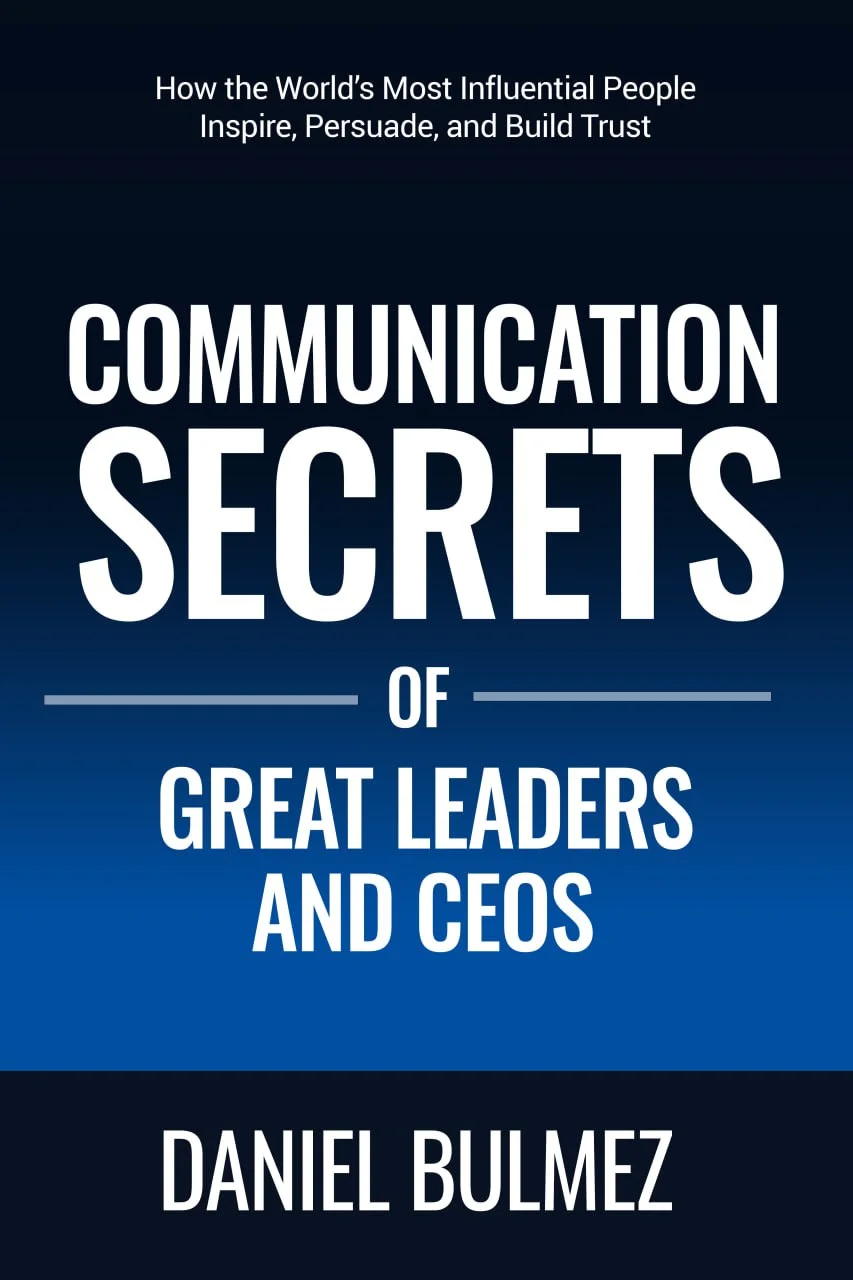
Communication isn’t something you’re born good at. It’s something you practice, and the best framework for practicing it is having a system. If you want to go deeper into the patterns behind how the best communicators operate, Communication Secrets of Great Leaders and CEOs breaks down the exact techniques that work in boardrooms, living rooms, and everywhere in between.
Daniel Bulmez is the author of Communication Secrets of Great Leaders and CEOs, available on Amazon.