


A few years ago, researchers at MIT strapped sensors to people during negotiations. They weren’t recording words. They were tracking tone, pacing, body movement, who leaned forward, who mirrored whom.
Then they tried to predict who would win the negotiation using only the sensor data. No transcripts. No content at all.
They predicted outcomes with 87% accuracy.
Let that land for a second. The words accounted for less than 13% of who won.
This is the uncomfortable truth about leadership communication: most of what determines whether people follow you, trust you, or tune you out is happening beneath the surface of language. And almost nobody is paying attention to it.
The leaders who dominate rooms, the ones who know how to command a room the moment they walk in, have figured this out. Not always consciously. But they’ve cracked communication patterns that the rest of the business world is still ignoring while obsessing over slide decks and talking points.
Here’s what they actually do.
1. Great Leaders Control the Tempo of a Room
Ever notice how some people speed up when they’re making an important point? It’s instinct. Urgency feels like emphasis.
Great leaders do the opposite. The bigger the moment, the slower they go.
When Satya Nadella took over Microsoft, a company that was culturally broken and losing relevance, his first meetings weren’t urgent. They were almost unsettlingly calm. He’d pause mid-sentence. Let things breathe. Speak at about two-thirds the pace of everyone else in the room.
It drove people slightly crazy at first. Then something clicked. The room started matching his tempo. Voices lowered. Interruptions stopped. People started thinking before they spoke instead of just reacting.
This is pacing as power. When you control the speed of a conversation, you control its depth. Fast-talking leaders get compliance. Slow, deliberate ones get people actually thinking.
Try this once: in your next high-stakes conversation, consciously cut your speaking speed by 30%. Watch what happens to the quality of the dialogue around you.
2. They Never Explain. They Reframe
In 2014, CVS made a decision that every analyst said was financial suicide. They pulled all tobacco products from their stores. $2 billion in annual revenue, gone overnight.
CEO Larry Merlo didn’t get on stage and defend the decision. He didn’t explain the health rationale or cite tobacco statistics. He did something far smarter.
He reframed the entire identity of the company. He said CVS was no longer a convenience store that happened to have a pharmacy. It was a healthcare company. And healthcare companies don’t sell cigarettes.
That’s it. One sentence, and the decision went from controversial to obvious.
This is what separates leaders who spend their lives justifying decisions from leaders who make decisions feel inevitable. They don’t argue within the existing frame. They change the frame entirely.
When Steve Jobs killed the floppy drive, he didn’t list reasons floppy disks were outdated. He said Apple builds the future, not the past. When Elon Musk gets questioned about rocket failures, he doesn’t apologize. He reframes failure as the fastest path to progress.
The pattern: don’t defend your position. Redefine the context until your position is the only one that makes sense. This is one of the most powerful communication secrets of great leaders, and it’s almost never taught in leadership programs.
3. They Know Exactly When to Shut Up
Here’s a number that will change how you communicate: after you ask someone a question, the average person waits 1.5 seconds before jumping back in.
One and a half seconds. That’s not a pause. That’s a reflex.
Great leaders wait five. Sometimes ten. Sometimes they let the silence stretch until it becomes genuinely uncomfortable, and then they wait a little more.
Why? Because the first answer anyone gives to a hard question is the safe answer. The rehearsed one. The one that protects them. The real answer (the insight, the concern, the idea they’re not sure they’re allowed to have) lives behind about seven seconds of discomfort.
Most leaders never hear it because they can’t tolerate the silence long enough.
Intel’s Andy Grove was famous for this. He’d ask something pointed in a meeting and then just… stare. Not aggressively. Patiently. Like a man who had absolutely nowhere else to be. People hated it. People also told him things they never told anyone else.
Effective leadership communication isn’t always about what you say. Sometimes the most powerful move is creating space for someone else to say the thing that actually matters.
4. They Use Specifics Like Weapons
“We need to improve customer satisfaction” is something every company says. Nobody remembers it. Nobody acts on it.
“Last Tuesday, a woman in Ohio waited 47 minutes on hold, then got transferred three times, then got disconnected. She’d been a customer for 11 years. She’s not anymore.”
Same topic. Completely different impact.
Specifics: real names, real numbers, real moments. These bypass the part of the brain that files things under “corporate noise” and hit the part that actually cares. Great leaders collect these details obsessively. They remember the name of the customer. The exact dollar amount lost. The date it happened.
It’s not about being dramatic. It’s about being concrete in a world drowning in abstraction. When everyone else is speaking in percentages and generalities, the leader who tells you about one specific customer on one specific day is the one you remember at the end of the week.
This is the CEO communication style that builds cultures where people care about outcomes, not just metrics. Numbers are forgettable. People aren’t.
5. They Give People an Identity, Not an Instruction
This one is subtle but it might be the most powerful communication secret of all.
There’s a classic study where researchers tried to get people to vote. One group was told “it’s important to vote.” The other group was told “you’re the kind of person who votes. A voter.”
The second group showed up to the polls at a significantly higher rate.
The difference? The first message was a task. The second was an identity. And people will break habits, change schedules, and go out of their way to act consistently with who they believe they are.
The best leaders have figured this out intuitively. They don’t say “work harder.” They say “we’re the team that doesn’t quit.” They don’t say “be more creative.” They say “this company was built by people who refuse to think inside the box. That’s who we hire.”
It’s the difference between managing behavior and shaping belief. One requires constant oversight. The other runs on autopilot.
Think about how great leaders communicate their expectations: not through memos and mandates, but by telling people who they already are at their best. That’s not motivation. That’s identity engineering.
What Makes These Patterns Different
Most leadership communication advice tells you what to do: listen more, be clear, show empathy. That advice isn’t wrong. It’s just useless. It’s like telling a struggling basketball player to “score more points.”
The patterns above are different because they’re mechanical. They’re specific moves you can practice, observe, and refine. Slow your tempo. Reframe instead of defending. Wait seven seconds after a question. Use one real story instead of ten data points. Speak to identity instead of behavior.
These aren’t personality traits. They’re executive communication skills that anyone can develop. And like any skill, they compound. The leader who masters two or three of these patterns will communicate more effectively than someone who’s read fifty books on “authentic leadership.”
The Full Playbook
Frequently Asked Questions
What are the communication secrets of great leaders?
Great leaders share several key communication patterns: they control the tempo of conversations rather than rushing through important moments, they reframe situations instead of defending decisions, they use strategic silence to draw out honest responses, they communicate with vivid specifics rather than abstract generalities, and they shape people’s identity rather than just giving instructions. These aren’t personality traits. They’re learnable skills that compound over time.
How do CEOs communicate differently than other leaders?
The CEO communication style is distinct because it operates at scale. CEOs must convey complex strategic decisions in ways that align entire organizations. The most effective ones rely heavily on reframing: changing how people see a situation rather than arguing within the existing frame. They also repeat core messages far more than feels necessary, because a message heard once in an all-hands meeting is forgotten by Tuesday.
Can leadership communication skills be learned?
Yes. The research is clear on this: effective communication is a set of mechanical skills, not an innate talent. Studies from MIT, Stanford, and behavioral psychology labs have identified specific patterns like pacing, strategic pausing, and identity-based language that can be practiced and measured. The best communication skills for leaders are the ones covered in this article: tempo control, reframing, strategic silence, specificity, and identity-based language. Most people never improve because they focus on what to say rather than how the delivery lands.
Why is communication important for leadership?
MIT research demonstrated that non-verbal communication patterns predicted negotiation outcomes with 87% accuracy, meaning the actual words accounted for less than 13% of the result. For leaders, this means that how you communicate determines whether people trust you, follow you, or tune you out. It’s not a “soft skill.” It’s the primary mechanism through which leadership is actually exercised.
What book covers communication secrets of leaders and CEOs?
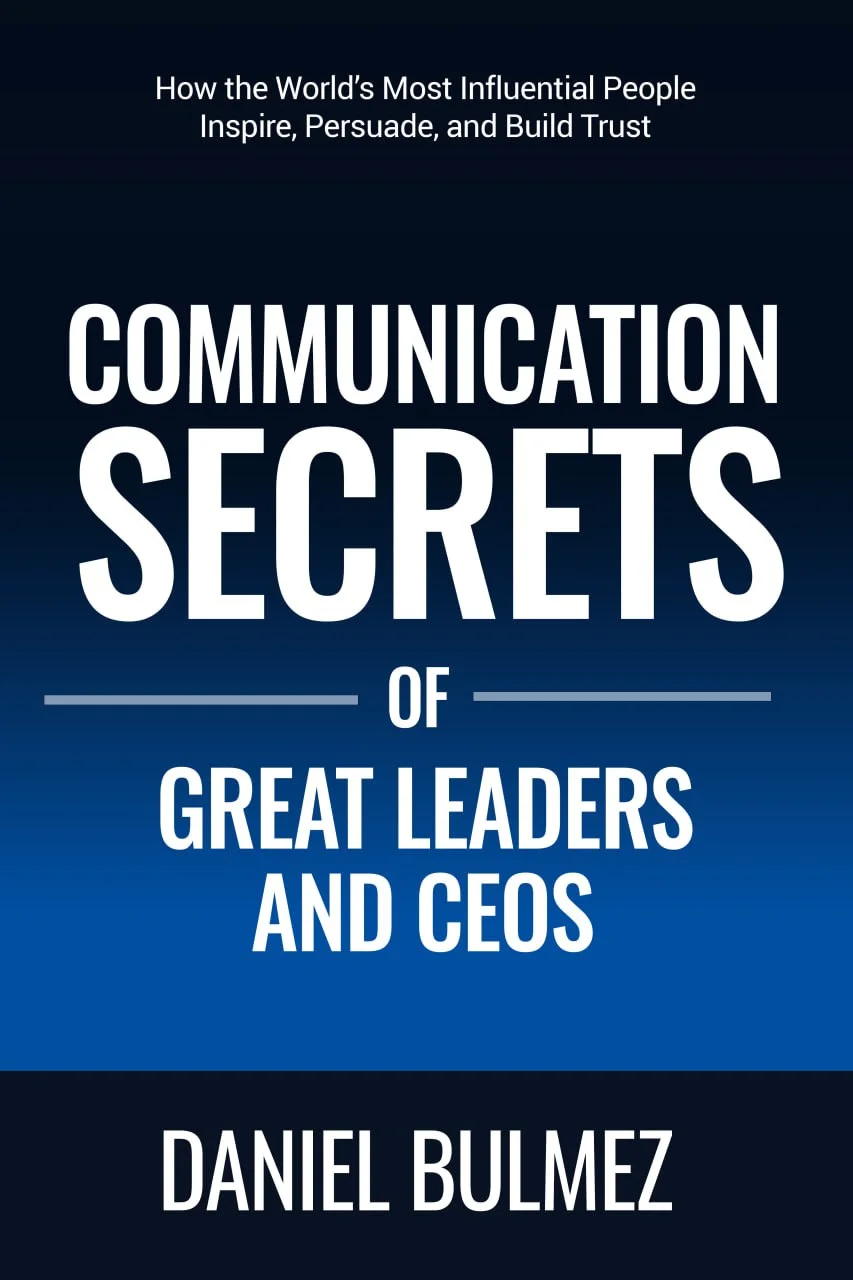
Communication Secrets of Great Leaders and CEOs by Daniel Bulmez is a comprehensive guide to the communication patterns used by top business leaders. It covers the full framework: from adapting your style across different audiences to delivering difficult messages without eroding trust.
Is leadership communication training worth it?
It depends on the format. Most leadership communication training programs focus on generic advice (“be authentic,” “listen actively”) which sounds good but doesn’t change behavior. The most effective approach is pattern-based: learning specific, mechanical techniques like strategic reframing, controlled pacing, and identity-based messaging. These are the same patterns used by CEOs who consistently move entire organizations with their words. Whether through formal training or self-study, the key is practicing specific moves, not absorbing abstract principles.