


What if the most important leadership skill has nothing to do with strategy, vision, or even intelligence? A 2021 study published in the Journal of Organizational Behavior found that leaders who scored high in emotional intelligence retained 20% more of their teams over a three-year period than leaders who scored high on IQ but low on EQ. The best part: it wasn’t close.
The gap between technically brilliant leaders who burn through people and the ones who build empires that last almost always comes down to emotional intelligence in leadership. Not as a soft skill. As the operating system everything else runs on. Here are six habits that define how the best CEOs actually use it.
1. They Read the Room Before They Speak
Most leaders walk into meetings with an agenda. Emotionally intelligent leaders walk in with a question: what’s the energy in this room right now?
When Satya Nadella became CEO of Microsoft in 2014, the company was known for its combative internal culture. Executives routinely interrupted each other. Meetings were battlegrounds. Nadella’s first move wasn’t a restructuring memo. He started sitting quietly in leadership meetings for the first five minutes, watching body language, noting who was tense, who was checked out. Former Microsoft VP Qi Lu described it as unsettling at first and then transformative. “He understood the room before he tried to change it.”
This isn’t mystical. It’s pattern recognition applied to people instead of data. An emotionally intelligent leader notices that the CFO keeps checking her phone (she’s distracted, not disengaged), that the engineering lead is leaning back with crossed arms (he disagrees but won’t say it), that the newest team member hasn’t spoken once (she’s intimidated, not disinterested).
Practical takeaway: Before your next meeting, spend the first two minutes observing instead of talking. Note three things about the emotional state of the room. You’ll be surprised how much it changes your approach.
2. They Name the Emotion Nobody Wants to Acknowledge
There’s a moment in every high-stakes conversation where something important goes unsaid. Fear. Frustration. Resentment. Most leaders push past it. Great leaders stop and name it.
Howard Schultz did this repeatedly during his second stint as Starbucks CEO from 2008 to 2017. When the company was hemorrhaging money during the financial crisis, Schultz called an all-hands meeting. Rather than leading with a turnaround plan, he opened with: “I know a lot of you are scared right now. I am too.” Starbucks employees who were at that meeting have described it as a turning point, not because of strategy, but because someone in power validated what everyone was already feeling.
Research from the University of California, Los Angeles supports why this works. Psychologist Matthew Lieberman found that the simple act of labeling an emotion reduces its intensity in the brain. When a leader names what people feel, the anxiety doesn’t disappear, but it shrinks enough that people can think clearly again.
Practical takeaway: The next time you sense tension in a room, try saying it out loud. “I think there’s some frustration here, and I want to hear it.” You’ll find that naming it defuses it.
3. They Respond to the Person, Not Just the Problem
When someone brings a problem to a technically focused leader, they get a solution. When someone brings a problem to an emotionally intelligent leader, they get acknowledged first, then a solution.
Indra Nooyi, during her 12-year tenure as PepsiCo CEO, was famous for a specific habit. When a direct report came to her with bad news, she would say some version of “Tell me what this means for you” before asking what it meant for the business. Her COO at the time, Hugh Johnston, later said this single behavior changed PepsiCo’s entire reporting culture. People stopped hiding problems because they knew they wouldn’t be reduced to the problem itself.
This matters more than it sounds. A 2020 study from the Center for Creative Leadership found that managers who demonstrated empathy toward direct reports were rated as better performers by their own bosses. Not by their teams, by their superiors. Emotional intelligence at work isn’t just good for morale. It shows up in performance reviews.
Practical takeaway: The next time someone brings you a problem, respond to how they seem before responding to the issue. One sentence is enough: “That sounds like it’s been weighing on you.” Then move to solutions.
4. They Control Their Reactions Under Pressure
Every leader faces moments where the instinctive response is the wrong one. Emotionally intelligent leaders have built a gap between stimulus and response that gives them room to choose.
Tim Cook is known at Apple for a particular kind of composure that borders on eerie. In supplier negotiations, in board meetings, even during the public pressure following the 2016 FBI encryption battle, Cook’s emotional register barely shifts. Former Apple executives describe it as strategic, not cold. Cook once told a reporter that his rule is simple: “If I feel the urge to react immediately, that’s exactly when I don’t.”
This isn’t suppression. It’s regulation. Daniel Goleman, the psychologist who popularized emotional intelligence, identifies self-regulation as the single skill that separates leaders who sustain influence from leaders who eventually implode. The data backs him up. A 2019 study from Yale’s Center for Emotional Intelligence found that leaders with strong self-regulation made 23% fewer impulsive decisions during crises compared to equally experienced leaders without it.
Practical takeaway: Build a two-second rule into high-pressure moments. Before you respond to anything that triggers a strong emotion, take one full breath. Not because breathing is magic. Because two seconds is enough to shift from reaction to response.
5. They Build Trust by Showing Vulnerability First
There’s a counterintuitive truth about emotional intelligence and leadership: the fastest way to establish authority is to show you don’t need to perform it.
When Alan Mulally took over as CEO of Ford in 2006, the company was losing $17 billion a year. His first leadership team meeting used a color-coded system: green for good, yellow for caution, red for trouble. Every single executive reported green. On a $17 billion loss. Mulally didn’t explode. He didn’t lecture. He smiled and said, “We’re going to lose seventeen billion dollars this year. Is there really nothing that’s not going well?” The next week, one executive, Mark Fields, showed up with a red slide. Mulally stood up and applauded him. Within a month, every meeting was full of reds and yellows. Within three years, Ford was profitable again, the only American automaker to survive the recession without a government bailout.
What Mulally understood was that vulnerability from the top creates psychological safety. And psychological safety, according to a landmark 2015 study from Google’s Project Aristotle, is the single strongest predictor of high-performing teams. It outranked every other factor, including talent, resources, and structure.
Practical takeaway: Share one honest struggle with your team this week. Not a manufactured confession. A real challenge you’re facing. Watch how it changes what people are willing to tell you.
6. They Give Feedback That Makes People Bigger, Not Smaller
The final hallmark of an emotionally intelligent leader is how they handle the hardest communication task in management: honest feedback that actually lands.
Mary Barra, CEO of General Motors since 2014, overhauled how the company delivers performance feedback. She replaced the traditional annual review with what GM internally calls “ongoing conversations.” The structure is specific: start with what the person does well (with evidence), then frame the growth area as an opportunity rather than a deficit, and always end with a question that gives the employee ownership. “What support would help you get there?” Barra has said publicly that this shift was the single most impactful culture change in her first five years.
The science lines up. Research from the NeuroLeadership Institute shows that feedback framed as threat activates the same brain regions as physical pain. Feedback framed as opportunity activates regions associated with learning and motivation. Same information, completely different neurological response. The best leaders know the difference and choose the frame deliberately.
Practical takeaway: Next time you need to give critical feedback, try this structure: “Here’s what you’re doing well [specific example]. Here’s where I see room to grow [specific observation]. What would help you move forward?” It takes 30 seconds longer and lands 10 times better.
The Thread That Ties It All Together
None of these habits are complicated. Reading a room. Naming emotions. Responding to people before problems. Controlling your reactions. Being vulnerable. Giving feedback that builds instead of breaks. But doing all six consistently is what separates emotionally intelligent leaders from everyone else.
The leaders who master this don’t just run better meetings or retain more talent. They build organizations where people actually want to do their best work. And the research is clear: emotional intelligence in leadership isn’t a nice-to-have. It’s the foundation that everything else depends on.
FAQ
Why is emotional intelligence important in leadership? Emotional intelligence matters because it directly impacts how leaders communicate, build trust, and make decisions under pressure. Research consistently shows that leaders with high EQ retain more employees, build stronger teams, and receive higher performance ratings from their own superiors. It’s the skill that determines whether technical competence translates into actual influence.
What are the signs of emotional intelligence in a leader? Signs of emotional intelligence include the ability to stay calm under pressure, respond to people’s emotions before jumping to solutions, give feedback without triggering defensiveness, and create environments where others feel safe speaking honestly. An emotionally intelligent leader reads the room accurately and adjusts their approach based on what they observe.
How can you develop emotional intelligence as a leader? Start with self-awareness. Track your emotional reactions for a week, noting what triggers strong responses and how you handle them. Practice naming emotions out loud in conversations. Build a pause between stimulus and response during high-pressure moments. Seek honest feedback from peers about how your behavior affects others. These habits compound quickly.
What is the difference between IQ and emotional intelligence in leadership? IQ measures cognitive ability: analytical thinking, problem-solving, processing speed. Emotional intelligence measures your ability to understand and manage emotions, both your own and other people’s. In leadership, IQ gets you to the table. Emotional intelligence determines whether people follow you once you’re there. Studies show EQ is a stronger predictor of leadership effectiveness than IQ in most organizational settings.
Can emotional intelligence be learned or is it innate? Emotional intelligence can absolutely be learned. Unlike IQ, which remains relatively stable throughout life, EQ is a set of skills that improve with deliberate practice. Daniel Goleman’s research shows that emotional intelligence skills are particularly responsive to coaching, feedback, and real-world practice. Most CEO-level leaders didn’t start with high EQ. They built it through experience and intentional effort.
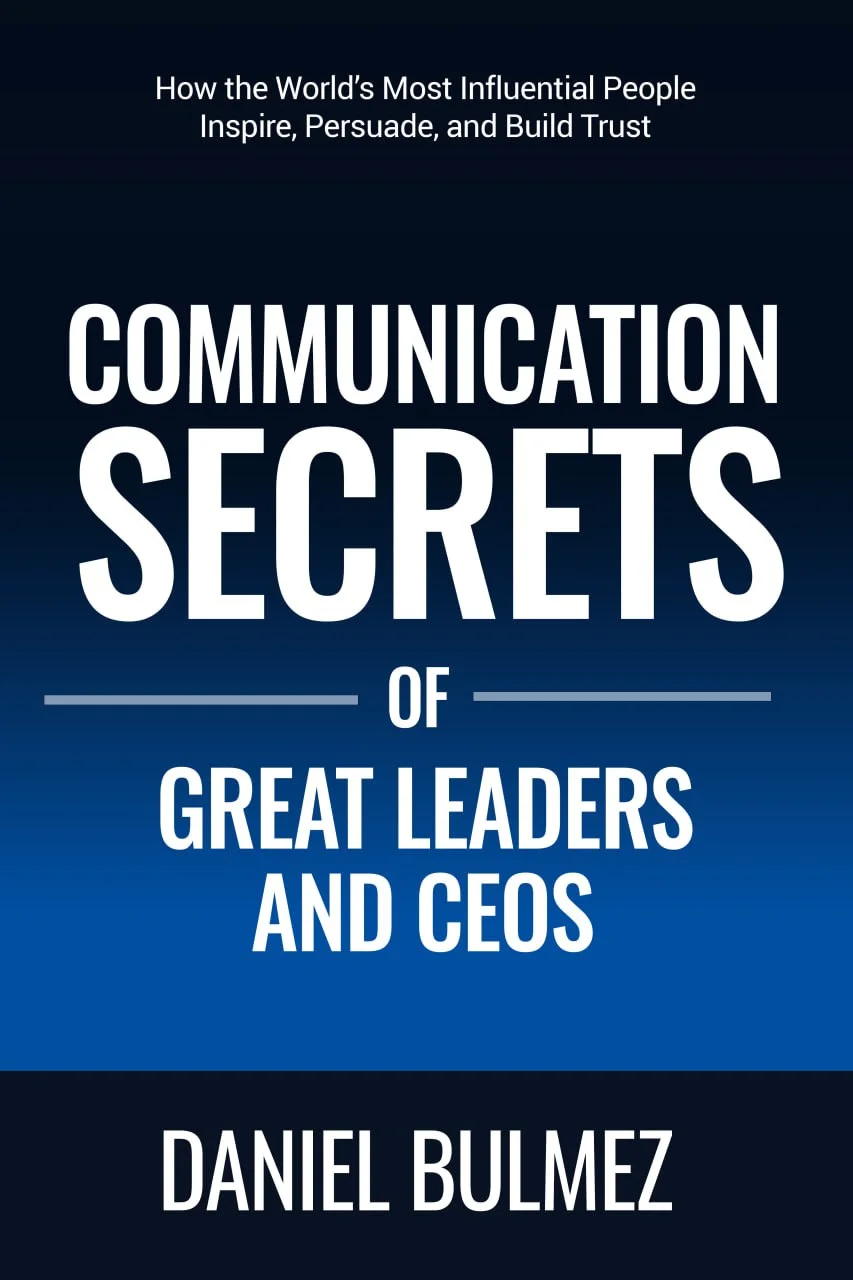
If these six habits feel like the surface of something deeper, they are. The patterns behind how great leaders communicate, influence, and build trust follow a system. Daniel Bulmez breaks that system down in Communication Secrets of Great Leaders and CEOs, with the specific frameworks, case studies, and strategies that turn emotional intelligence from a concept into a daily practice.
Daniel Bulmez is the author of Communication Secrets of Great Leaders and CEOs, available on Amazon.