15 Public Speaking Tips Great Speakers Actually Use (That Most People Get Wrong)
Public speaking tips that work in the real world — the 15 moves great speakers actually use, and the popular advice that quietly makes you worse.
 Daniel
May 20, 2026
8 min read
36 views
Daniel
May 20, 2026
8 min read
36 views

Most public speaking advice is theatre advice — how to perform. The speakers who actually move rooms are doing something different.
If you’ve ever Googled “public speaking tips,” you’ve already met the same recycled list a thousand times: imagine the audience in their underwear, make eye contact, speak from the diaphragm, smile more. None of it is wrong. Almost none of it is what separates a forgettable talk from one people quote a year later.
The speakers who run rooms — keynote presenters, courtroom litigators, CEOs on earnings calls, pastors with full pews — are running a different playbook. Less theatre, more substance. Less performance, more presence. Here are 15 tips that actually move the needle, drawn from how great speakers actually operate.
1. Open With the Stake, Not the Setup
Most speakers waste their first 90 seconds thanking the host, telling the audience how excited they are, and walking through what they’re about to cover. By the time you say anything real, the room has already mentally checked their phones.
Great speakers open with a single sentence the audience can’t ignore — a claim, a story beat, a number, a question. The setup, the thanks, the housekeeping — that comes after you’ve earned the right to be listened to. Stake first. Logistics later.
2. Talk Like a Person, Not Like a Speech
The fastest way to lose a room is to sound like someone giving a speech. The cadence stiffens, the vocabulary inflates, the contractions disappear. The audience hears “performance” and emotionally backs away.
Talk the way you talk to a smart friend who’s interested. Same vocabulary you’d use over dinner. Same rhythm. Same willingness to say “actually” and “look” and “here’s the thing.” Authority comes from how rooted you sound, not how formal.
3. Slow Down — Then Slow Down Again
Almost everyone speaks too fast under pressure. Adrenaline compresses time. What feels glacial to you sounds normal-fast to the audience. What feels comfortable to you sounds rushed.
The most underrated public speaking tip in existence: build deliberate pauses into your material. Not just at section breaks — between sentences that matter. The silence after a key sentence is what lets it land. Speakers who fear silence speak over their own best lines.
4. Stop Memorizing. Start Internalizing.
Memorized speeches sound memorized. The audience can feel the recital — the eyes drifting up and to the left as you reach for the next line. The performance is happening for the audience, not with them.
Internalize the structure — opening, three to five anchor points, closing. Know each point well enough that you can speak about it for two minutes off the cuff. The exact words can vary. The arc cannot. That’s the difference between a presenter and a speaker.
5. Use One Story Per Idea
Data convinces. Stories move. You need both, but in the right order — story first to open the door, data second to lock it in.
For every important point in your talk, attach one short, concrete story. Not a parable. A specific moment, with a specific person, in a specific place. “Last Tuesday, in our 9:30 meeting, Sarah said…” beats any abstract framing. The brain remembers people and places. It forgets adjectives.
6. Eye Contact Is Per Thought, Not Per Sweep
The textbook advice — “sweep your eyes around the room” — produces a strange dead-eyed effect that everyone has seen and no one trusts. You look like a lighthouse.
The real move: hold eye contact with one person for the length of one complete thought, then move to the next. Three to seven seconds. The person you’re looking at feels spoken to directly. The rest of the room reads the intimacy from a distance and trusts it. One person at a time. Always.
7. Park Your Hands When They’re Not Working
Untrained hands betray nerves more than any other body part. They wander, fidget, hover, grip the podium. Audiences notice without realizing they’re noticing.
Default position: hands relaxed at your sides or lightly together at waist height. Use them deliberately when a gesture supports the point — then return them to the default. Active when they’re working. Quiet when they’re not. The contrast is what makes the gestures land.
8. Volume Is a Tool, Not a Setting
Most speakers pick a volume at the start and stay there. Great speakers move through dynamic range like a musician. The intentional drop in volume — going quieter at the most important sentence in the talk — pulls the audience forward in their seats. Going louder for emphasis works because you’ve earned the contrast.
Monotone volume is the audio equivalent of beige.
9. Don’t Apologize Before You Begin
“Sorry, I’m a bit nervous.” “I’m not great at this.” “I had to throw this together last minute.”
The audience didn’t notice your nerves until you announced them. They didn’t know you weren’t a great speaker until you positioned yourself as one. Pre-apologies are a self-protection move that hands the room permission to take you less seriously. Don’t disclaim your way out of credibility before you’ve used any of it.
10. Address the Resistance Out Loud
If there’s an obvious objection in the room — a controversial claim, a skeptical audience, a topic people are tired of — name it before they do.
“I know everyone in this room has heard ten talks on AI this month. Here’s what’s different about this one.”
Saying the resistance out loud disarms it. Pretending it isn’t there lets it grow.
11. End With a Single Sentence They’ll Repeat
The last line of your talk is the one the audience carries out the door. Most speakers waste it on “thank you” or “any questions?”
Write your last sentence first. Make it short, declarative, and emotionally weighted. It should be repeatable — the kind of line someone could text to a friend in 20 seconds. The whole talk exists to set up the line.
12. Use the Stage. Don’t Pace It.
Pacing comes from nervous energy with nowhere to go. Stage movement that works is directional — you walk to a position when you start a new idea, you stay there while you make it, you move when you transition.
Each physical location becomes anchored to a different idea in the audience’s memory. Same logic as putting different topics in different corners of a whiteboard. Use the space as structure, not as something to burn off adrenaline.
13. Read the Room — and Then Actually Adjust
Most speakers run their planned talk regardless of what the room is doing. Eyes glazing over? Same script. Laughter dying? Same script. Energy spiking on one point? Same pace.
Great speakers monitor in real time and adjust on the fly. Cut a section that’s losing the room. Stretch a section that’s landing. Drop a planned joke if the energy can’t carry it. The script is a draft. The room is the final editor.
14. Q&A Is the Real Performance
Most speakers treat Q&A as the cool-down after the talk. It’s actually the opposite — Q&A is where the audience decides whether the talk was real or rehearsed. A speaker who handles unscripted questions with the same authority as the prepared material proves they actually live inside the material.
Prep for it. Brainstorm the ten hardest questions in advance. Rehearse short, honest answers. The single best answer to a question you don’t know: “I don’t know.”
15. Record Yourself. Watch It Back. Cringe. Repeat.
The single fastest way to improve as a speaker is also the most uncomfortable: film yourself, watch the playback, take notes. Every speaker who reaches a high level does this. Most people who plateau as speakers refuse to.
You’ll see the tics, the filler words, the energy drops, the spots where the eyes drift. The cringe is the price of admission. Two or three cycles of this beats a year of reading books on public speaking.
What Most Public Speaking Advice Misses
Almost all popular public speaking advice treats the talk like a performance. Adjust the volume, adjust the eye contact, adjust the hand gestures — like a checklist for a play.
The speakers who actually run rooms are doing something the checklist misses: they’re not performing the material. They’re living inside it in front of an audience. Every tip on this list is downstream of that one shift. When you actually believe what you’re saying, when the material matters to you, when you’ve earned the right to be the person delivering it — the volume and the eye contact and the pauses calibrate themselves.
The technique is real. But the technique is in service of presence, not the other way around.
The Deeper Playbook
Public speaking is one slice of a bigger skill: the ability to make words land under pressure. The leaders who build empires, win cases, and close billion-dollar rooms all share the same underlying communication mechanics — and they’re rarely the ones taught in standard speaking courses.
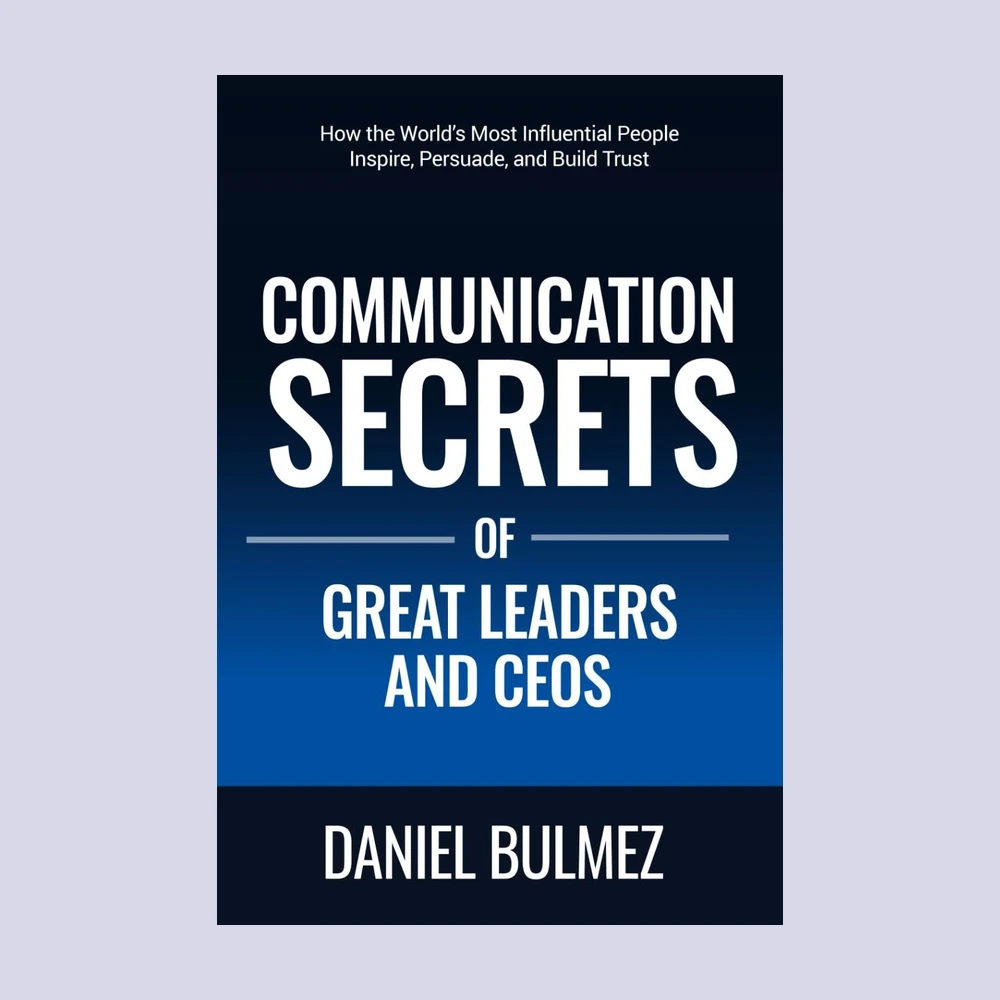
That’s the territory of Communication Secrets of Great Leaders and CEOs — the actual moves great communicators use to build authority, not stagecraft. The book breaks down the patterns that show up across boardrooms, keynotes, negotiations, and high-stakes conversations, so you can put them to work the next time you have to speak and have it matter.
The room doesn’t reward the smoothest performer. It rewards the most credible one. Becoming that person is a learnable skill.
Daniel Bulmez is the author of Communication Secrets of Great Leaders and CEOs, available on Amazon.