


Why do some leaders get a “yes” almost effortlessly while others struggle to sell even their best ideas? It’s not charisma. It’s not authority. According to a 2023 study from the Wharton School of Business, the most persuasive leaders don’t push harder. They create conditions where agreement feels like the other person’s idea.
The gap between leaders who persuade and leaders who merely present is enormous. And it comes down to a handful of specific persuasion techniques that great CEOs use every day, often without anyone noticing. Here are seven of them.
1. Lead With Their Problem, Not Your Solution
The most common persuasion mistake in business? Starting with what you want. The best leaders flip it. They open with the problem the other person is already feeling, then position their ask as the logical resolution.
When Satya Nadella took over as Microsoft CEO in 2014, he didn’t announce a new strategy and demand buy-in. He spent his first months asking teams one question: “What are you struggling with?” By the time he proposed the shift to cloud-first, it wasn’t his idea being imposed. It was the answer to problems people had already articulated. The reorganization that followed saw Azure revenue grow from $4.4 billion to over $60 billion within eight years.
The psychology behind this is straightforward. People resist being told what to do. But they lean into solutions that address their own pain. Frame your pitch around their frustration, and you skip past most resistance entirely.
Practical takeaway: Before any pitch or proposal, write down the top three problems your audience is dealing with. Open with those, not your solution.
2. Use Strategic Silence After Key Points
Most people fill silence with more talking. Great persuaders do the opposite. They make their point, then stop. The silence forces the other person to sit with the idea, process it, and often talk themselves into agreement.
Tim Cook is famous for this at Apple. In negotiations and board meetings, Cook will make a statement and then go completely quiet, sometimes for 30 seconds or more. Former Apple executives have described it as uncomfortable and incredibly effective. The silence communicates confidence in the position, and it transfers the pressure to the other side.
Research from the University of Groningen found that even a four-second pause in conversation creates a sense of gravity around whatever was just said. The listener’s brain assigns more weight to the preceding statement. In persuasion psychology, this is one of the most underused tools available.
Practical takeaway: After your most important point, stop talking for at least five seconds. Resist the urge to explain further. Let the weight of the statement do the work.
3. Give Something Before You Ask for Something
Robert Cialdini’s principle of reciprocity is one of the foundational principles of persuasion. But knowing about it and executing it well are different things. The CEOs who master the art of persuasion don’t offer generic favors. They give something specific, unexpected, and valuable before they ever make their ask.
Howard Schultz, during his second stint as Starbucks CEO starting in 2008, needed store managers to buy into painful changes: closing underperforming locations, retraining every barista in the country. Before asking for any of it, he announced expanded healthcare benefits for part-time workers and a tuition reimbursement program. The message was clear: I’m investing in you before I ask you to invest in this. The company’s turnaround plan rolled out with remarkably little internal resistance.
This works because the human brain tracks social debts instinctively. When someone gives us something valuable, we feel compelled to reciprocate, even if we don’t consciously realize it.
Practical takeaway: Before your next big ask, identify one meaningful thing you can give the other party first. Not a token gesture. Something they’d genuinely appreciate.
4. Anchor the Conversation With a Number
Anchoring is one of the most reliable persuasion strategies in negotiation, and the best leaders use it far beyond the negotiating table. The first number mentioned in any discussion becomes the reference point for everything that follows, regardless of whether it’s reasonable.
Elon Musk does this constantly. When he announced Tesla’s original Roadster in 2006, he anchored the price of an electric vehicle at $109,000. When the Model S launched at $57,400 in 2012, it felt almost reasonable by comparison, even though it was one of the most expensive sedans on the market. The anchor reframed what “expensive” meant in the context of electric vehicles.
A study published in the Journal of Applied Psychology found that negotiators who set aggressive anchors achieved outcomes 15-20% better than those who let the other side go first, even when the anchor was arbitrary. Your brain can’t help using that first number as a benchmark.
Practical takeaway: In any negotiation or proposal, be the first to name a number. Set it higher (or lower, depending on your goal) than your actual target. The conversation will orbit around that anchor.
5. Tell a Story Instead of Making an Argument
Data convinces the analytical mind. Stories convince the whole person. The most persuasive leaders know that storytelling in leadership isn’t a soft skill. It’s the single most effective way to move people to action.
When Brian Chesky needed Airbnb’s board to approve a massive investment in experiences (not just lodging) in 2016, he didn’t present market research. He told the story of one host in Havana who had transformed her living room into a cooking class. He described the reviews, the repeat visitors, the way it changed her income. By the end, the board wasn’t evaluating a business pivot. They were imagining a grandmother in Havana whose life was better because of their company. The “Experiences” category launched that November.
Neuroscience research from Princeton shows that when someone hears a story, their brain activity begins to mirror the storyteller’s. Neural coupling, as researchers call it, literally puts the listener in the speaker’s shoes. No spreadsheet has ever done that.
Practical takeaway: For your most important persuasion moments, replace at least one data slide with a specific human story. Name the person. Describe the situation. Let the audience feel it before you explain what it means.
6. Frame the Choice, Don’t Eliminate It
People hate feeling cornered. The moment someone senses they have no choice, resistance spikes. Great leaders understand this and use persuasion techniques that preserve the other person’s sense of autonomy while guiding them toward a preferred outcome.
Indra Nooyi mastered this during her tenure as PepsiCo CEO (2006-2018). When she wanted to shift the company toward healthier products, she didn’t mandate it. She presented the board with three paths: continue the current trajectory (with projected health-regulation risks), make a partial shift (moderate investment), or go all-in on “Performance with Purpose.” Each option was real. But the way she framed the risks and opportunities made the third choice almost inevitable. The board voted unanimously for the full strategy.
This aligns with what psychologists call the “autonomy bias.” A meta-analysis in the Personality and Social Psychology Bulletin found that simply adding the phrase “but you are free to choose” to a request increased compliance by 50%. People are dramatically more likely to say yes when they feel the decision is theirs.
Practical takeaway: Never present a single option. Offer two or three, with your preferred choice positioned as the most logical path. Let them pick it rather than accept it.
7. Show Vulnerability Before Asking for Trust
The instinct in business is to project strength, especially when persuading. But research consistently shows that selective vulnerability is one of the most powerful persuasion skills a leader can develop. It signals honesty, which is the precondition for trust, which is the precondition for persuasion.
When Jamie Dimon addressed JPMorgan shareholders after the $6.2 billion “London Whale” trading loss in 2012, he didn’t minimize or deflect. He called it “a terrible mistake,” said the bank’s risk oversight had failed, and took personal responsibility before laying out the remediation plan. The stock, which had dropped 9% on the news, recovered within months. Shareholders didn’t just accept the fix. They trusted the person presenting it because he had been honest about the failure.
Brené Brown’s research at the University of Houston has shown that vulnerability in leaders doesn’t reduce perceived competence. It increases perceived authenticity, and authenticity is the foundation of how to be persuasive in any high-stakes environment.
Practical takeaway: Before your next big ask, acknowledge one genuine challenge or mistake openly. Not as a tactic. As an honest setup for why your proposal matters.
FAQ
What are the most effective persuasion techniques?
The most effective persuasion techniques combine psychology with strategic communication. Leading with the other person’s problem (not your solution), using strategic silence, offering value before asking, anchoring with specific numbers, storytelling, framing choices, and showing selective vulnerability are all proven approaches used by top business leaders. The key is that real persuasion skills feel natural, not manipulative.
How does persuasion psychology work in business?
Persuasion psychology works by aligning your message with how the human brain naturally processes decisions. Cognitive biases like anchoring (fixating on the first number mentioned), reciprocity (feeling obligated to return favors), and the autonomy bias (needing to feel in control of choices) are hardwired. Leaders who understand these principles of persuasion don’t fight human nature. They work with it.
What is the difference between persuasion and manipulation?
Persuasion seeks a mutually beneficial outcome by presenting information in the most compelling way possible. Manipulation exploits someone’s vulnerabilities for one-sided gain. The test is simple: would the other person still agree if they fully understood your intent? Ethical persuasion strategies pass this test. Manipulation doesn’t.
Can persuasion techniques be learned?
Absolutely. Persuasion is a skill, not a personality trait. Research from Carnegie Mellon University shows that people who study and practice specific persuasion techniques improve their influence outcomes by 30-40% within months. The art of persuasion is accessible to anyone willing to study the principles and practice them deliberately.
How do CEOs use persuasion in leadership?
CEOs use persuasion in leadership primarily through framing, storytelling, and strategic generosity. Rather than relying on positional authority (which creates compliance, not commitment), effective leaders create conditions where people persuade themselves. The techniques in this article, from anchoring to vulnerability, are drawn from documented CEO behaviors at companies like Microsoft, Apple, and PepsiCo.
The seven strategies above aren’t tricks. They’re patterns that show up again and again in how the most effective leaders communicate. Persuasion, at its core, is about understanding people well enough to present your ideas in a way that genuinely resonates with them.
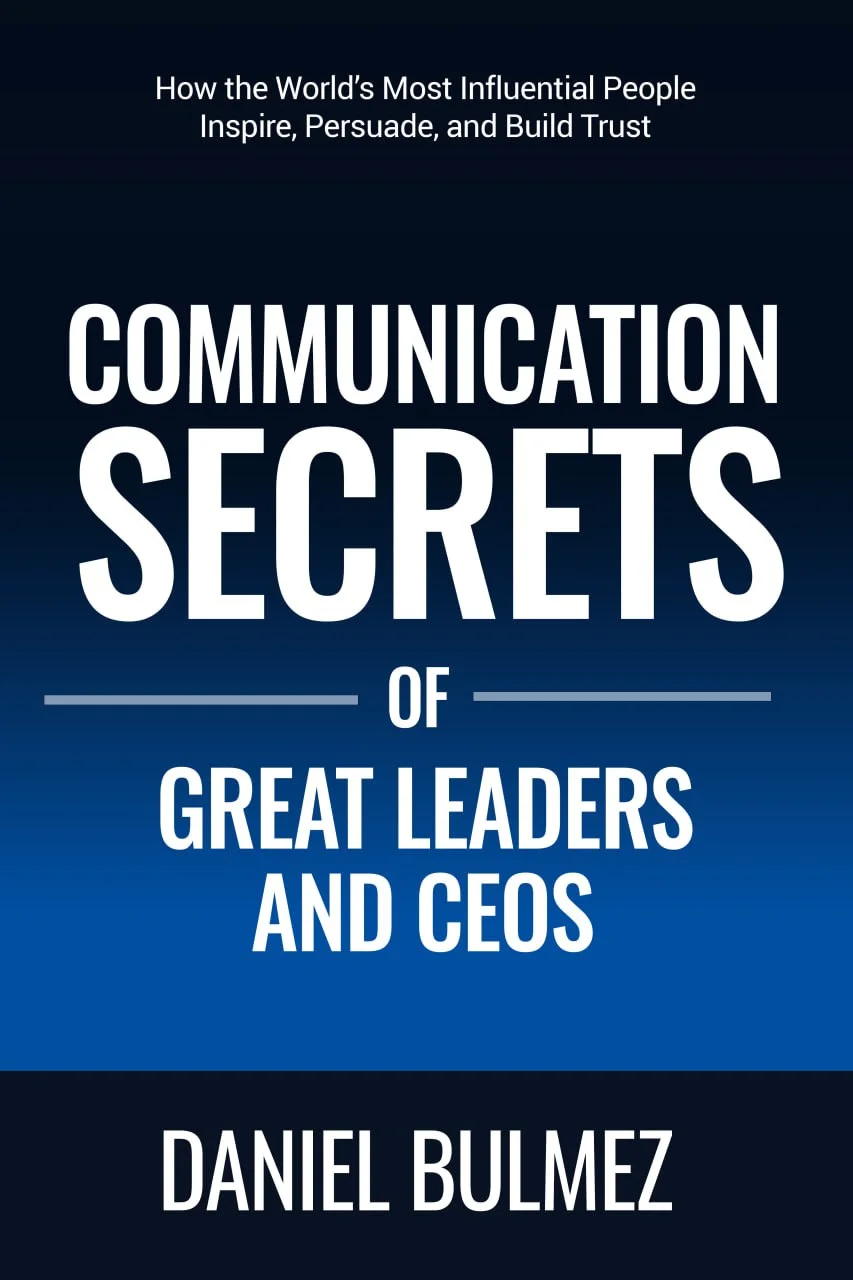
If you want to go deeper into the communication systems that great leaders actually use, including the frameworks behind these techniques and dozens more, Communication Secrets of Great Leaders and CEOs lays out the complete playbook. It’s the system behind the surface patterns.
Daniel Bulmez is the author of Communication Secrets of Great Leaders and CEOs, available on Amazon.