The Carl Jung Quote That Explains Why Your Life Keeps Repeating Itself
Carl Jung said until you make the unconscious conscious, it will direct your life and you will call it fate. Here is how to actually do it.
 Daniel
April 25, 2026
4 min read
156 views
Daniel
April 25, 2026
4 min read
156 views
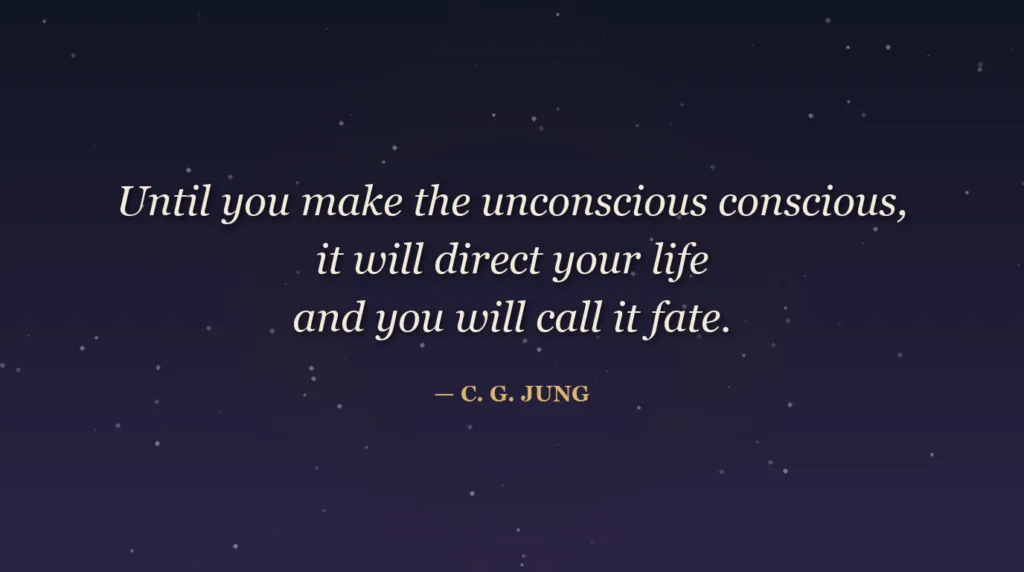
There is a single sentence from Carl Jung that has done more damage to comfortable self-deception than almost anything else in modern psychology:
“Until you make the unconscious conscious, it will direct your life and you will call it fate.”
— Carl Jung
It sounds poetic. It is actually surgical. Jung is saying that the script you are running — the one that picks the same kind of partner, the same kind of fight, the same flavor of self-sabotage — is not destiny. It is a program. And until you can see it, you will keep mistaking the program for the world.
Most people read this quote, nod, and scroll past. The ones who let it land start to notice something uncomfortable: their life has a pattern, and the pattern is not random.
Why “Fate” Is Just an Unexamined Pattern
Jung’s claim rests on a now well-documented neuroscience fact: the conscious mind processes a sliver of what the brain is actually doing. Research from cognitive scientists like Stanislas Dehaene and Daniel Kahneman converges on the same idea — your felt sense of “deciding” is downstream of decisions your brain has already made.
That means most of your reactions are pre-loaded. You don’t choose to flinch when a partner says a certain phrase. You don’t choose to suddenly feel small when a particular type of person walks into the room. You don’t choose the tone of voice that escapes you in conflict. Those are the unconscious driving the car.
Call it fate, and you stay a passenger. Call it a pattern, and you can finally pull it apart.
The Three Places It Hides
Jung spent his career mapping where the unconscious lives. In modern terms, you can usually catch it in three places:
1. Your repeats. The same argument with a different person. The same job that drained you under a new title. The same disappointment in friendships you thought were finally different. When the cast changes but the script doesn’t, the script is yours.
2. Your overreactions. The moments where the size of your reaction does not match the size of the trigger. A small comment lands like a knife. A minor delay feels like betrayal. That is almost always an old wound being touched, not a new one being created.
3. Your “I always” statements. “I always end up the responsible one.” “I always get overlooked.” “I always pick the wrong people.” Anything you say with that flat certainty is usually less an observation about life and more a confession about a pattern you have not yet examined.
How You Actually Make It Conscious
Jung did not just diagnose the problem — he prescribed the work. The translation, stripped of mystique, is roughly this:
- Catch the moment. When you feel a disproportionate reaction, freeze the frame. Do not act on it. Just watch it.
- Trace it backwards. Ask: when have I felt exactly this before? Not similar. Exactly. The body remembers what the mind has filed away.
- Name it out loud. Patterns lose half their power the second you can describe them in a clean sentence. “I make myself small whenever someone reminds me of my father.” That sentence, said honestly, does more than a year of vague self-help.
- Choose the alternative once. You do not need to break the pattern forever today. You need to interrupt it once, on purpose, so your nervous system learns that the old script is no longer the only script.
Where This Bites Hardest
The unconscious shows up loudest in two arenas: relationships and the way you communicate. Most people will spend their entire adult life having the same five conversations on a loop — the same defensiveness, the same shutdowns, the same need to be right, the same fear of being seen — and never realize that the conversation is not happening in the room. It is happening between their unconscious and the person standing in front of them.
If you want a working playbook for catching those patterns in real time — and rewriting how you actually speak, lead, and hold your ground in a room — that is exactly what Communication Secrets of Great Leaders and CEOs unpacks: how the highest performers learn to notice their own scripts before the scripts run them, and how to communicate from the conscious self instead of the inherited one.
Jung’s line is not a poster quote. It is a dare. Look at the parts of your life you have been quietly calling “just how things go for me,” and ask the question he was actually asking: Is this fate — or is this a pattern I haven’t made conscious yet?
The honest answer is almost always the second one. Which means almost all of it is still negotiable.
Daniel Bulmez is the author of Communication Secrets of Great Leaders and CEOs, available on Amazon.