Best Books for Curious Kids Who Ask “Why” All Day
Real, tested picks for endlessly questioning 6-9 year olds — the best books for curious kids who never stop asking why, from a childrens author who has read them all.
 Daniel
July 16, 2026
5 min read
28 views
Daniel
July 16, 2026
5 min read
28 views

Some kids ask one why a day. Others ask one why per minute, and by dinner you’ve fielded questions about volcanoes, black holes, why dogs sniff each other, and whether ghosts are real — all before the food gets cold. If that’s your kid, regular story books aren’t the fix. What actually works are books built for a mind that wants to know why, not just what happens next.
The good news is that this exact kind of curious kid has been well served by publishers for decades. Here are the books that hold up best against a relentless question-asker, with the ones we’ve actually built for this exact kid featured alongside the classics of the genre.
Smart Kids Ask Why: The History of the World
Curious kids are usually curious about everything, and history is one of the biggest playgrounds for “why did that happen.” This book runs 101 full-color pages from the first ice-age campfires all the way to the moon landing, and every page is one big moment: a full-page illustration, four bite-sized facts, and a fun fact that usually gets read out loud twice. A recurring kid-explorer character asks the questions right alongside your child, which keeps it feeling like a conversation instead of a lecture. Built for ages 7 and up, and it’s the book we made specifically for kids who won’t stop asking why.
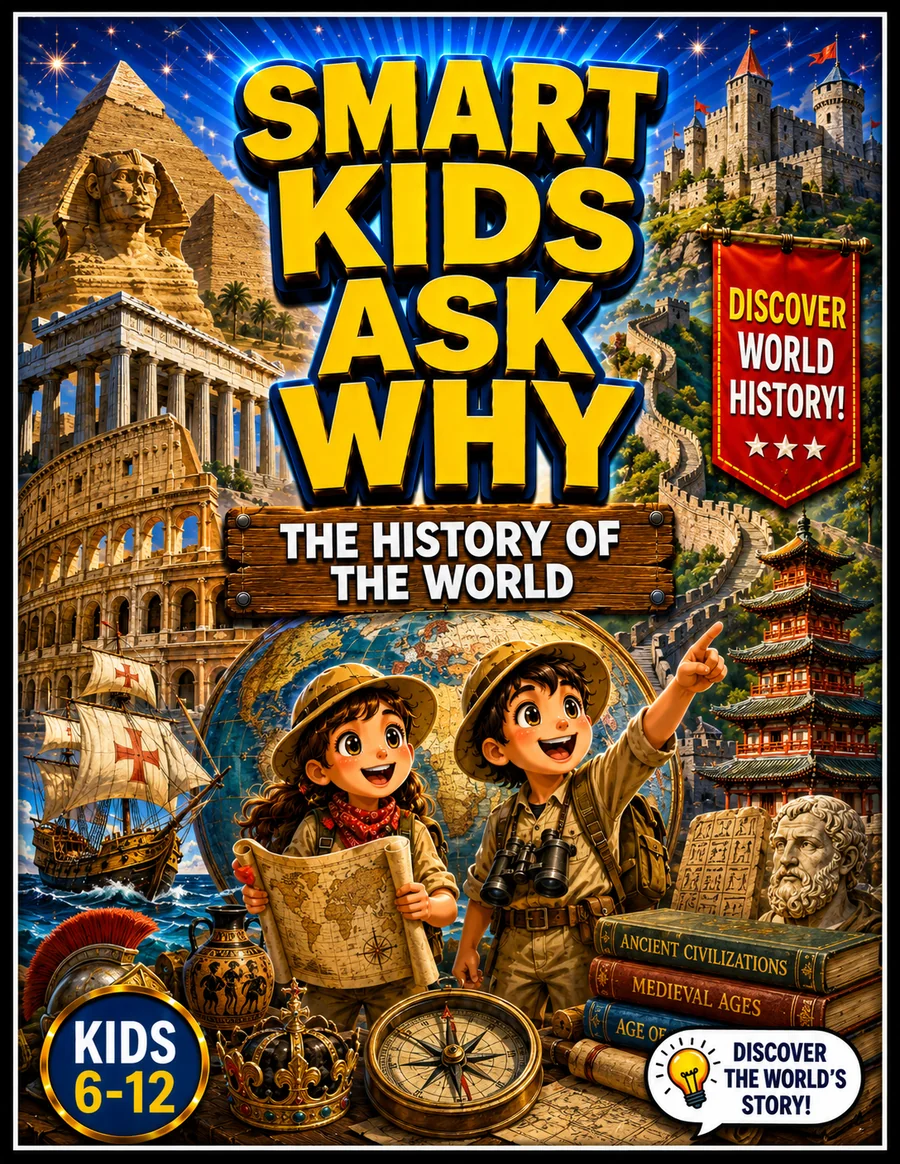
Find it here on our store.
Smart Kids Ask Why: Dinosaurs!
If curiosity has a favorite subject in your house, odds are good it’s dinosaurs at some point. This one is built entirely around the “why” format — 112 full-color pages, and literally every page opens with a why: why did T. rex have such tiny arms, why did some dinosaurs grow feathers, why did they disappear. Profile-card spreads dig into around twenty famous dinosaurs, including T. rex and the enormous Giganotosaurus, which kids love arguing about as the “real” biggest predator.
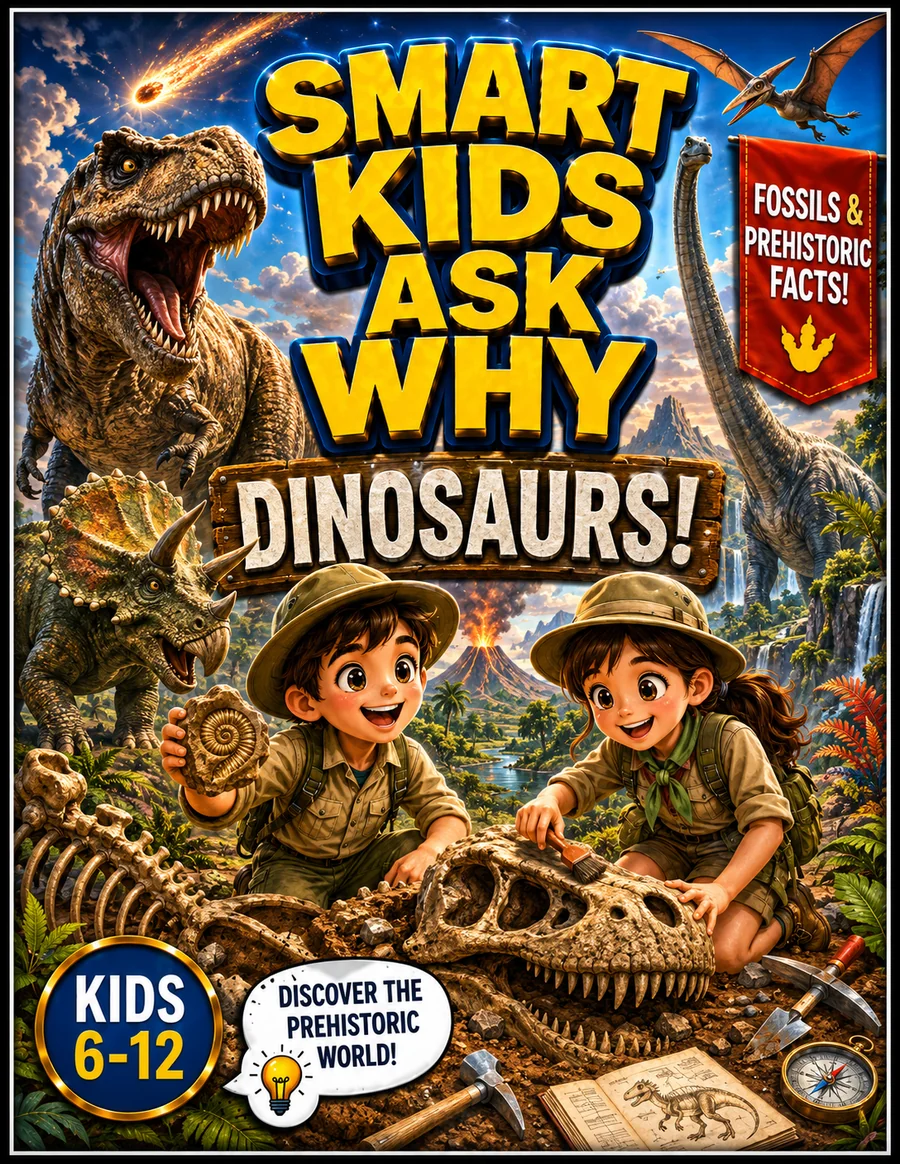
Available here.
Why? Over 1,111 Answers to Everything (National Geographic Kids)
National Geographic’s entry into the genre leans on its biggest strength: real photography instead of illustrations, paired with a genuinely huge spread of topics. It works best as a book kids dip in and out of rather than read cover to cover, and some entries run a little text-heavy for the younger end of the curious-kid range, but the sheer range of subjects makes it a reliable answer machine for years.
The Big Book of Why (TIME for Kids)
A genre classic for good reason — the question selection is exactly what real kids ask, not what an adult thinks they should ask (“Why do I get brain freeze?” is a perfect example). The layout looks a little dated compared to newer full-color books, but the content still holds up, and the loose organization means kids can flip to whatever catches their eye instead of reading start to finish.
Weird But True! (National Geographic Kids)
Less a question-and-answer book than a firehose of standalone facts, which makes it an oddly perfect fit for a kid whose curiosity runs in every direction at once. Each page is a handful of short, punchy facts with no real connective structure — great for short attention spans, less great if your kid wants deeper explanations of why something is true rather than just that it is.
Britannica All New Kids’ Encyclopedia
Not a Q&A book in format, but it earns a spot here because it runs on the same instinct that drives curious kids: it’s honest about how much we don’t know, right alongside what we do. Beautifully produced, image-heavy, and organized enough to support both browsing and actual research for school projects — a nice bridge between fun-fact books and something more substantial.
Tell Me Why by Arkady Leokum
This is arguably where the whole “why” genre started, and it’s still worth having on the shelf for an older curious kid. It’s text-heavy and mostly black-and-white, so it’s a poor fit for a picture-book-aged child, but a strong 9-to-12-year-old reader who wants more depth than a one-paragraph answer will get real mileage out of it.
DK Knowledge Encyclopedia
For the kid whose curiosity has outgrown one-fact-per-page and wants the whole picture: cutaway diagrams, cross-sections, and dense visual spreads instead of isolated facts. Less “why is the sky blue” and more “here is the entire atmosphere, labeled and sliced open.” A good next step once a kid has burned through the lighter fact books and wants more to chew on.
How to Pick the Right One
- Match the format to your kid’s current reading level, not their curiosity level. A book with the perfect topic but the wrong reading level gets abandoned fast — curiosity doesn’t override frustration for long.
- Full color and one-question-per-page win under age 9. Kids that age are reading with their eyes as much as the words.
- Let obsession pick the topic. A dinosaur-obsessed 6-year-old will push through a book aimed at 9-year-olds if the subject is right, and skip an easier book about anything else.
There’s no single “best” book for a curious kid — there’s the book that gets picked back up the next day without being asked. Start with whichever topic your kid is currently obsessed with, and let the questions lead the way from there.
Once your kid works through this list, our books like 100,000 Whys roundup has eight more picks built for the same nonstop question-asker.
Got a kid who is locked onto one topic? Start with the best animal facts books for kids, the best space books for kids, or the best fun fact books for kids. Younger readers will also like our picks of the best educational books for 7-year-olds.
Daniel Bulmez is the author of the Smart Kids Ask Why book series, available on this store and on Amazon.