


Have you ever watched someone walk into a room and instantly get taken seriously? Before they’ve said a word, before anyone knows their title, something about them commands attention. That quality has a name. Researchers call it executive presence. And despite what most people assume, it has almost nothing to do with charisma.
In 2005, a researcher named Nalini Ambady showed study participants 30-second silent video clips of surgeons. No words. No context. Just body language and facial expressions.
Then she asked them to rate the surgeons’ competence.
Those ratings predicted, with statistical significance, which surgeons had been sued for malpractice and which hadn’t. Thirty seconds. No medical information whatsoever.
This is the science behind what the business world calls executive presence. It’s the quality that makes someone look like they belong at the top of the room before they’ve said a single word. So what is executive presence, really? And more importantly, can you build it if you weren’t born with it?
The research says yes. Here’s how.
What Executive Presence Actually Means
The executive presence meaning that most people carry around is wrong. They picture a tall, loud, commanding figure who dominates every conversation. Think the stereotypical Wall Street executive or a military general.
But when the Center for Talent Innovation studied over 4,000 professionals to define executive presence, they found something different. It breaks down into three dimensions:
Gravitas (67%): How you act. Your composure under pressure, your decisiveness, your ability to read a room and respond appropriately.
Communication (28%): How you speak. Not volume or vocabulary. Clarity, conciseness, and the ability to make complex things simple.
Appearance (5%): How you look. This matters far less than people think, but it’s not zero.
The numbers tell the story. Nearly all of executive presence is behavioral. It’s about what you do, not who you are. That’s what makes it learnable.
1. They Speak With Fewer Words, Not More
One of the clearest markers of executive presence is economy of language. People who have it say less. But what they say carries more weight.
Jeff Immelt, during his time as CEO of GE, had a rule for his direct reports: if you can’t explain it in one page, you don’t understand it well enough. This wasn’t about brevity for its own sake. It was a test of thinking. The person who uses 500 words when 50 would do isn’t being thorough. They’re being unclear.
Compare how most middle managers present to how a CEO does. The manager shows 30 slides. The CEO asks one question that reframes the entire discussion.
If you want to develop executive presence, start by cutting your communication in half. In emails, in meetings, in presentations. Find the core point and lead with it. Let the silence after your words do the work that extra sentences never could.
2. They Stay Calm When Everyone Else Speeds Up
Watch what happens in a meeting when unexpected bad news hits. Most people react immediately. Their voices rise. Their speech accelerates. They jump to solutions before they understand the problem.
Now watch the person in the room with executive presence. They pause. They might lean back slightly. When they finally speak, their pace is measured and their voice is steady.
This isn’t acting. It’s a practiced response that researchers call “emotional regulation under observation.” When people see someone stay calm during a crisis, they unconsciously assign that person higher competence and leadership capability.
Mary Barra demonstrated this repeatedly as GM’s CEO during the ignition switch crisis. In congressional hearings, with cameras everywhere and lawmakers pressing hard, she never raised her voice or rushed her answers. The content of her responses mattered, of course. But the delivery is what made people believe she was in control of a situation that was objectively out of control.
Developing executive presence starts with this: the next time pressure hits, deliberately slow your breathing and your speech by 20%. That gap between stimulus and response is where presence lives.
3. They Hold Eye Contact a Beat Longer Than Comfortable
There’s a small behavioral difference between people who are perceived as powerful and people who aren’t. It takes about half a second.
Research from the University of British Columbia found that high-status individuals maintain eye contact approximately 0.5 seconds longer during key moments in conversation. Not staring. Not aggressive. Just slightly longer than the social default.
This tiny difference signals confidence, attentiveness, and authority. It says: I’m not looking away because I’m not intimidated by this moment.
Most people break eye contact when they feel uncertain, when the topic gets difficult, or when they’re thinking about what to say next. Leaders with executive presence do the opposite. They lean into the discomfort of sustained attention.
Try this in your next one-on-one: when someone finishes making a point, hold eye contact for a full second before responding. That pause communicates more respect and authority than any words could.
4. They Take Up Space Without Taking Over
Executive presence has a physical component that goes beyond appearance. It’s about how you occupy space.
Amy Cuddy’s research at Harvard (despite the controversy around “power posing”) pointed to something that subsequent studies have confirmed: expansive body language changes how others perceive you. People who sit upright, use open gestures, and position themselves centrally in a room are rated as more competent and more leader-like.
But this isn’t about dominance. The leaders with the strongest executive presence aren’t the ones who spread out aggressively or tower over others. They’re the ones who are physically still. They don’t fidget. They don’t shift in their chairs. They don’t touch their face or cross their arms defensively.
Satya Nadella is a perfect example. He’s not physically imposing. He doesn’t gesture dramatically or raise his voice. But when he sits in a room, he’s completely still and completely focused. That stillness reads as control, and control reads as competence.
5. They Choose When to Weigh In, Not Whether
The final piece of developing executive presence is knowing when to speak and when to listen. And most aspiring leaders get this backward.
They think presence means having an opinion on everything. So they comment on every agenda item, chime in on every thread, and volunteer for every discussion. This doesn’t build presence. It dilutes it.
Warren Buffett speaks publicly a handful of times per year. When he does, the financial world stops to listen. That’s not because he’s smarter than everyone else. It’s because scarcity has made his words valuable. If he commented on every market fluctuation, he’d be just another voice in the noise.
The leaders with the strongest executive presence in organizations are often the ones who stay quiet through the first 80% of a discussion. Then, when they speak, they synthesize what’s been said, name the core tension, and point toward a direction. One contribution that reframes everything.
Being selective about when you weigh in is not disengagement. It’s leadership influence at its most efficient.
The Skill Most Leaders Ignore
Executive presence isn’t a personality trait. It’s not something you’re born with, and it’s not reserved for people who look or sound a certain way. It’s a specific set of communication behaviors that can be identified, practiced, and refined.
Speak less. Stay calm under pressure. Hold eye contact through the uncomfortable moments. Be physically still. Choose your moments to contribute.
These are not abstract concepts. They’re concrete, daily practices. And the compounding effect is significant. A leader who develops even two or three of these behaviors will be perceived differently within weeks, not months.
Going Deeper
Frequently Asked Questions
What is executive presence?
Executive presence is the combination of behaviors that make someone appear competent, authoritative, and leader-like. Research from the Center for Talent Innovation breaks it into three components: gravitas (how you act under pressure), communication (how clearly and concisely you speak), and appearance. Gravitas accounts for 67% of how executive presence is perceived, making it primarily a behavioral skill rather than an innate trait.
How do you develop executive presence?
Developing executive presence requires practicing specific behaviors: speaking concisely, maintaining composure under pressure, holding eye contact during important moments, reducing physical fidgeting, and being selective about when you contribute to discussions. These are mechanical skills that improve with deliberate practice, not personality traits you either have or don’t.
Why is executive presence important for leadership?
Research shows that people form judgments about competence and leadership capability within seconds, often before any words are spoken. Executive presence is the mechanism through which those snap judgments are formed. Leaders who develop it get more buy-in, earn trust faster, and are more likely to be selected for senior roles. It’s the visible layer of leadership influence.
Is executive presence training worth it?
The most effective executive presence training focuses on specific behaviors rather than vague advice like “be more confident.” Programs that teach concrete skills (pacing, eye contact, physical stillness, selective contribution) produce measurable results. Self-directed learning through books and deliberate practice can be equally effective for motivated individuals.
What are the best executive presence books?
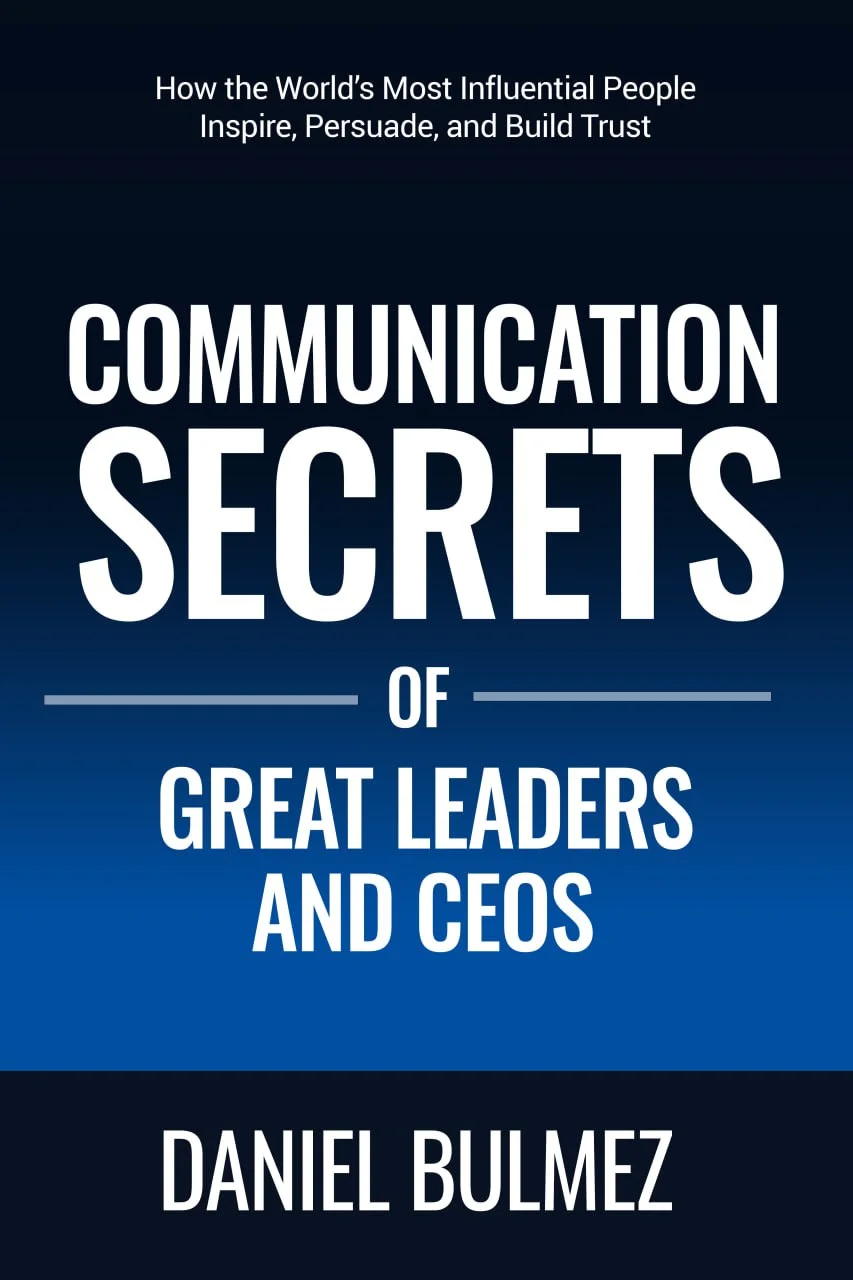
For a practical, pattern-based approach to the communication skills that drive executive presence, Communication Secrets of Great Leaders and CEOs by Daniel Bulmez covers the full framework. It focuses on observable patterns from real leaders rather than abstract theory, making it immediately applicable.
How do you speak like a CEO?
CEOs communicate with extreme clarity and brevity. They lead with conclusions, not context. They use specific numbers instead of vague qualifiers. They speak slowly and deliberately, especially during high-stakes moments. Learning how to speak like a CEO comes down to these communication skills for leaders, and they can all be practiced. The key shift is moving from “saying more to be thorough” to “saying less to be clear.”