


What if the most important leadership qualities have nothing to do with being loud, charismatic, or the smartest person in the room?
A 10-year study by Harvard Business Review tracked over 17,000 leaders across industries and found something that surprised the researchers: the highest-performing leaders scored lowest on “assertive confidence” and highest on consistency, emotional regulation, and the ability to make others feel heard. The qualities we romanticize in leaders are often the opposite of what actually works.
Here are the 10 leadership qualities that research, history, and the world’s most effective CEOs consistently point to.
1. Decisiveness Under Uncertainty
Great leaders make calls when the data is incomplete. Not recklessly, but deliberately.
When Satya Nadella took over Microsoft in 2014, the company was stuck in a “Windows-first” identity crisis. Nadella made the counterintuitive decision to open-source Microsoft’s developer tools and embrace Linux, a platform Microsoft had openly warred against for a decade. The board wasn’t unanimous. The old guard resisted. But Nadella decided quickly and committed fully.
The result: Microsoft’s market cap went from $300 billion to over $3 trillion under his leadership.
Decisiveness isn’t about being right every time. It’s about refusing to let ambiguity become an excuse for inaction. Average managers wait for consensus. Great leaders gather input, set a deadline for the decision, and move. If they’re wrong, they correct fast. But they never stall.
Practical takeaway: Set a “decision deadline” for every open question on your plate. If you can’t get perfect information by that date, decide with what you have. Indecision costs more than a wrong call you can adjust.
2. Emotional Self-Regulation
This is the leadership quality most people underestimate and the one that predicts long-term success most reliably.
A Yale study on emotional intelligence in executives found that leaders who could regulate their emotional responses during high-stress situations retained 40% more of their team over a 3-year period compared to reactive leaders. People don’t leave companies. They leave leaders who can’t manage their own emotional weather.
Howard Schultz built Starbucks into a global brand, but his most defining leadership moment came during the 2008 financial crisis. With the stock down 75% and 600 stores closing, Schultz returned as CEO and made a decision that seemed irrational at the time: he shut down every single Starbucks location in America for one afternoon to retrain baristas on espresso quality. Wall Street called it a stunt. Internally, it was a signal. Schultz stayed calm when everyone around him was panicking, focused on what he could control (product quality), and refused to let the crisis energy infect his decision-making.
Practical takeaway: When you feel a surge of frustration, anger, or anxiety in a leadership moment, institute a “90-second rule.” Neuroscience shows that the chemical lifecycle of an emotion in the body is about 90 seconds. If you can pause before reacting, the intensity passes and your prefrontal cortex (rational thinking) comes back online. Try our Self-Confidence Quiz to see how well you manage pressure.
3. The Ability to Listen Without an Agenda
Most leaders listen to respond. The best leaders listen to understand, and the difference is visible in about 30 seconds.
Alan Mulally, who turned Ford around from a $12.7 billion loss in 2006 to profitability by 2009, was famous for a practice he called “working together.” In his weekly Business Plan Review meetings, he required every executive to present their area’s status as red, yellow, or green. The first week, every single one was green. In the middle of the worst financial crisis in Ford’s history.
Mulally didn’t get angry. He simply said, “We’re going to lose $17 billion this year. Is there really nothing that’s not going well?” The next week, Mark Fields (later Ford CEO) showed up with a red slide about a production issue. Mulally stood up and clapped. Literally applauded the honesty.
That single moment changed Ford’s culture. People started telling the truth because the leader made it safe to do so.
Practical takeaway: In your next meeting, try this: after someone finishes speaking, pause for three full seconds before you respond. Then start with “What I heard you say is…” before adding your perspective. It forces genuine processing, not performative listening. Curious about your communication patterns? Take our Communication Style Quiz.
4. Accountability That Starts With Yourself
Great leaders don’t point fingers downward. When something fails, they absorb the blame. When something succeeds, they redirect the credit.
Jamie Dimon at JPMorgan Chase demonstrated this during the 2012 “London Whale” trading loss, a $6.2 billion disaster caused by a risk management failure in the Chief Investment Office. Dimon didn’t fire people and distance himself. He went on national television, called it “a terrible, egregious mistake,” and took personal responsibility before the Senate Banking Committee. He cut his own bonus by 50%.
Behind the scenes, he restructured the risk management framework and strengthened oversight. But publicly, he never let the blame flow downhill. The result: JPMorgan’s stock recovered faster than analysts expected because investors trusted a leader who owned his failures.
Contrast this with leaders who say “my team dropped the ball” in public. Every person hearing that knows the truth: this leader will sacrifice you to protect themselves.
Practical takeaway: Next time something goes wrong on your watch, resist the instinct to explain who caused it. Start with “I take responsibility for this” and then pivot to “here’s what we’re changing.” Your team will notice. They will remember.
5. Vision That’s Simple Enough to Repeat
If your vision requires a PowerPoint to explain, it’s not a vision. It’s a strategy document.
When John F. Kennedy said “We choose to go to the Moon in this decade,” it was nine words that aligned an entire nation. When Jeff Bezos told early Amazon employees “We’re going to be the most customer-centric company on Earth,” it passed the hallway test: any employee could repeat it from memory.
The leadership quality here isn’t having a vision. Everyone has a vision. It’s having the discipline to simplify it until it’s repeatable, memorable, and actionable at every level of the organization.
Reed Hastings at Netflix distilled the company’s culture into a 127-page slide deck that became legendary in Silicon Valley. But the core of it fit in one sentence: “Act in Netflix’s best interest.” That simple phrase replaced an entire policy manual. No vacation tracking, no expense approvals, no travel budgets. Just six words that every employee could internalize and apply.
Practical takeaway: Write your vision or mission in one sentence. Show it to five people on your team without context. If they can’t repeat it back to you within 24 hours, it’s not simple enough. Cut words until they can.
6. Courage to Make Unpopular Decisions
Leadership is not a popularity contest, and the leaders who try to make everyone happy end up making no one happy, including themselves.
When Arne Sorenson became CEO of Marriott International, he made the unpopular decision to merge loyalty programs after the Starwood acquisition in 2016. Loyal Starwood members were furious. The internet backlash was significant. Travel bloggers predicted mass defections. Sorenson pushed forward anyway because he knew a unified loyalty program would be stronger for customers in the long run, even if the transition was painful.
Within two years, Marriott Bonvoy became the largest hotel loyalty program in the world with over 150 million members. The decision that everyone hated became the competitive advantage everyone envied.
Practical takeaway: Before making a decision, ask yourself: “Am I avoiding this because it’s wrong, or because it’s uncomfortable?” If the answer is uncomfortable, that’s usually a signal to move forward, not retreat. Great leadership often lives on the other side of a difficult conversation. Take our Leadership Style Quiz to see how you handle these moments.
7. Genuine Curiosity About People
The best leaders are genuinely interested in the people around them, not as resources to deploy, but as humans to understand.
Indra Nooyi, former CEO of PepsiCo, was known for something unusual: she wrote personal letters to the parents of her direct reports. Not form letters. Handwritten notes thanking them for raising their children to become the kind of people who make PepsiCo better. She visited some of their homes.
When asked about it, Nooyi said, “I wanted to connect who they are at work with who they are as people.” Her executives didn’t just respect her. They were loyal in a way that transcended professional obligation.
This quality isn’t about being “nice.” It’s about recognizing that people give their best work to leaders who see them as whole humans, not interchangeable parts. The data backs this: a Gallup study found that employees who feel their manager cares about them as a person are 2.7 times more likely to be engaged at work.
Practical takeaway: Learn one non-work fact about each person on your team this week. Their kid’s name. What they did last weekend. What they’re excited about outside of work. Then remember it and ask about it next time. It costs you nothing and changes how people experience your leadership.
8. Consistency Over Intensity
Inconsistent leaders create anxious teams. When people don’t know which version of the boss they’re going to get today, they spend energy managing upward instead of doing their work.
Tim Cook at Apple is the embodiment of this quality. He’s not flashy. He doesn’t give rousing, Jobsian keynote speeches that make you want to run through a wall. What he does is show up the same way every single day: prepared, calm, detail-oriented, and relentless about operational excellence. Since taking over as CEO in 2011, Cook has grown Apple’s revenue from $108 billion to over $380 billion. Not through dramatic pivots or visionary moonshots, but through consistent execution at an elite level.
The lesson: consistency compounds. A leader who delivers 7 out of 10 every day will outperform a leader who swings between 10 and 3, because the team around the consistent leader can actually build on a stable foundation.
Practical takeaway: Pick three leadership behaviors that matter most to your role (showing up prepared, responding within 24 hours, giving honest feedback). Commit to doing them every single day, not when you feel like it, not when it’s convenient, but every day. Consistency builds trust faster than any single grand gesture.
9. The Willingness to Develop Other Leaders
Average managers build teams that depend on them. Great leaders build teams that can function without them.
Jack Welch at GE was polarizing in many ways, but his commitment to developing leaders was unmatched. GE’s Crotonville leadership center became the gold standard for corporate leadership development. Under Welch, GE produced more Fortune 500 CEOs than any other company in history. People like Jim McNerney (Boeing), Bob Nardelli (Home Depot), and Jeff Immelt (GE itself) all came through Welch’s leadership pipeline.
Welch spent 30% of his time on people development. Not because he was generous, but because he understood a fundamental truth: the ceiling of any organization is the quality of its leaders, and if you’re the only one, you are the bottleneck.
Practical takeaway: Identify one person on your team who could do your job in 18 months with the right development. Start giving them increasing responsibility this week. If this feels threatening, that’s your ego talking, not your leadership.
10. Integrity When No One Is Watching
This is the foundational leadership quality. Without it, every other quality on this list is performance.
Warren Buffett has repeated the same hiring philosophy for decades: “We look for intelligence, energy, and integrity. And if they don’t have the third, the first two will kill you.” It’s not just a quote. Buffett has walked away from deals worth billions when the ethics didn’t pass his test. In 2014, he publicly killed a Burger King-Tim Hortons tax inversion deal restructure that would have been legal but ethically questionable.
Integrity isn’t about following rules. It’s about what you do when the rules don’t cover the situation. Do you take the easy path that no one would question, or the right path that might cost you something?
Your team knows the difference. They always know.
Practical takeaway: Think about your last three decisions where you had a choice between what was easy and what was right. If all three were the easy path, that’s data. Leadership integrity isn’t a personality trait; it’s a practice, and it atrophies without exercise.
What Makes These Qualities Different
Notice what’s missing from this list. There’s no mention of charisma, public speaking ability, industry expertise, or being the hardest worker in the room. Those are nice-to-haves, not need-to-haves.
The leadership qualities that actually matter are mostly internal: how you regulate yourself, how you treat people, how consistent you are, and whether you operate with integrity when it costs you something. These aren’t exciting qualities. They don’t make for good movie scenes. But they’re what separates leaders who endure from those who flame out.
If you want to assess where you currently stand, try our Leadership Style Quiz or the Communication Skills Quiz to identify your strengths and blind spots.
FAQ
What are the most important leadership qualities? The most important leadership qualities are emotional self-regulation, decisiveness under uncertainty, accountability, and integrity. Research consistently shows that leaders who manage their emotions, make timely decisions, own their mistakes, and operate ethically retain better teams and produce stronger long-term results than those who rely on charisma or technical expertise alone.
Can leadership qualities be developed? Yes. While some people have natural tendencies toward certain leadership qualities, every quality on this list is a skill that can be practiced and strengthened. Emotional regulation improves with deliberate practice. Listening skills sharpen with feedback. Even integrity is a muscle that strengthens through consistent exercise. The key is treating leadership development as ongoing practice, not a one-time training event.
What is the difference between leadership qualities and leadership skills? Leadership qualities are the underlying character traits and dispositions that shape how you lead, like integrity, curiosity, and emotional regulation. Leadership skills are the specific, teachable abilities like delegation, public speaking, and strategic planning. Qualities are who you are. Skills are what you do. The best leaders develop both, but qualities without skills produce well-meaning ineffectiveness, while skills without qualities produce effective toxicity.
How do leadership qualities affect team performance? A Gallup study of over 100,000 teams found that managers account for 70% of the variance in team engagement. When leaders demonstrate consistency, genuine interest in their people, and accountability, teams report higher engagement, lower turnover, and stronger performance. The specific mechanism is trust: teams that trust their leader take more risks, communicate more openly, and recover from setbacks faster.
What leadership quality is most overlooked? Consistency is by far the most overlooked leadership quality. People admire vision and celebrate courage, but consistency is what teams actually need. A leader who shows up the same way every day creates psychological safety, reduces anxiety, and gives teams a stable foundation to build on. It’s not glamorous, but it compounds over time into something more powerful than any single heroic decision.
The qualities that make great leaders aren’t complicated. They’re just hard to sustain. If you want to go deeper into the communication patterns behind these leadership qualities, particularly how the best CEOs build trust, resolve conflict, and influence without authority, that’s exactly what I break down in my book.
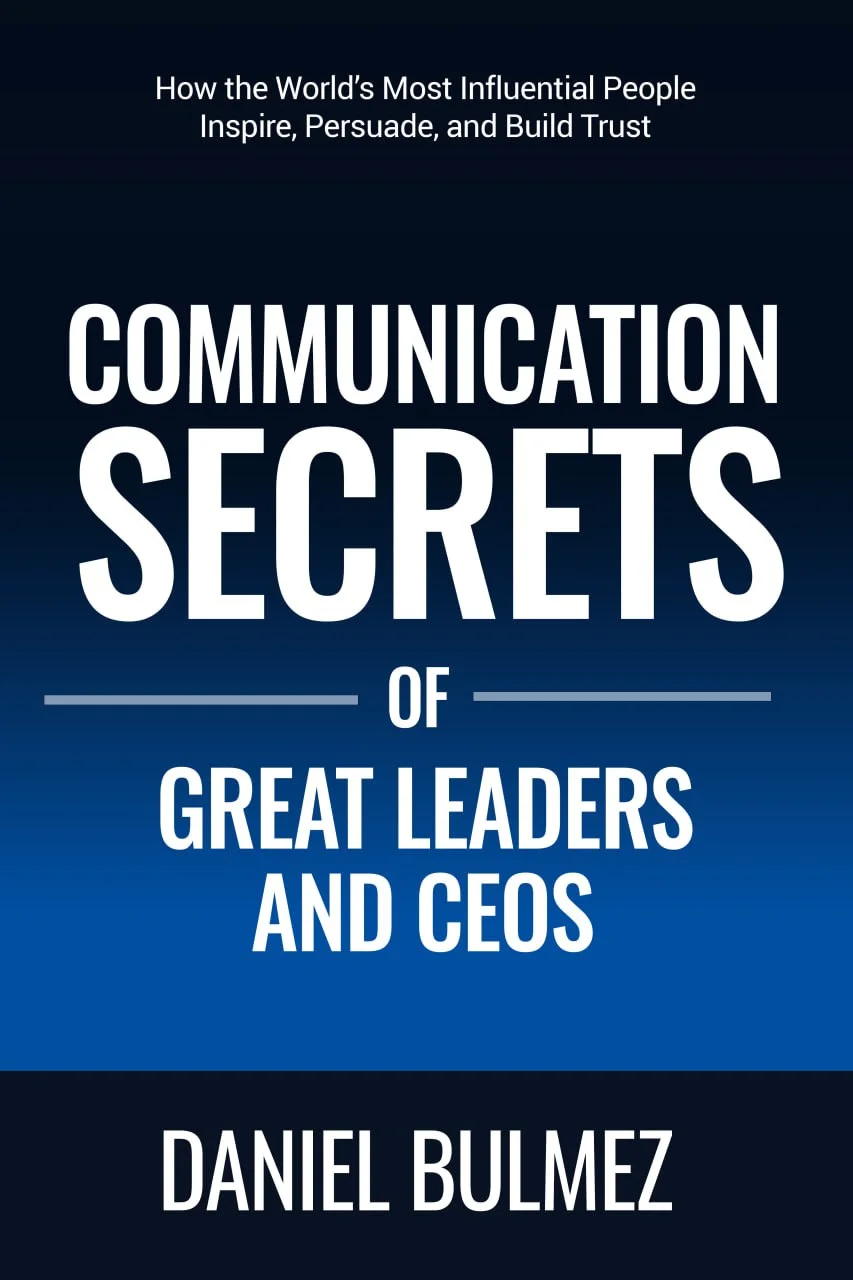
Get Communication Secrets of Great Leaders and CEOs on Amazon →
Daniel Bulmez is the author of Communication Secrets of Great Leaders and CEOs, available on Amazon.