Storytelling for Business: How to Tell a Story That Actually Lands
Storytelling for business that actually moves people. The 7 moves great leaders use to make ideas stick, sell, and survive long after the slide deck closes.
 Daniel
June 9, 2026
5 min read
30 views
Daniel
June 9, 2026
5 min read
30 views

Data informs. Stories move. Every leader figures this out eventually — usually the hard way, after a flawless deck full of charts gets a polite nod and zero follow-through. The decks that change minds, the pitches that close, the all-hands moments that shift a whole company — they all share the same engine. Storytelling for business isn’t a soft skill. It’s the operating system the best leaders run on top of everything else.
This is the practical playbook. Not “tell more stories.” Specific moves you can use in your next meeting, deck, or pitch.
1. Lead With the Person, Not the Point
Most business stories start at the wrong end. The speaker opens with the conclusion — the strategy, the framework, the number — and then tries to backfill the human stakes. By minute two, the audience is checking their phones.
Great storytellers reverse the order. They open with a person in a specific moment. A nurse standing over a chart at 3 a.m. A founder counting cash to make payroll. A customer staring at a checkout screen.
When the audience can see a face, they lean in. Once they’re in, then you bring in the data, the strategy, the ask. Information without a face is forgettable. Information attached to a person is unforgettable.
2. Anchor in Conflict — Not Achievement
Stories without tension are reports. And nobody quotes a report at the dinner table.
The most powerful business stories are built around a real conflict: a missed deadline that nearly killed the launch, a customer who almost walked, a quiet team member who turned out to be carrying the whole project. The conflict doesn’t have to be dramatic. It just has to be honest.
Skip the highlight reel. Highlight reels create distance. Show the moment something almost fell apart — and what it took to hold it together. That’s the part listeners remember, and it’s the part that makes your win mean something.
3. Use the One-Sentence Hook
Every great business story has a single sentence that does the heavy lifting. It’s the part you’d repeat to a friend in an elevator. If your story doesn’t have one, the audience will leave with nothing to carry.
A few examples of the form:
- “We were a week from shutting down when one customer email changed everything.”
- “He’d been with the company nineteen years, and nobody had ever asked him what he thought.”
- “The model said no. The founder said yes. The founder was right.”
Build this sentence before you build anything else. If the hook works, the rest of the story almost writes itself. If it doesn’t, no amount of polish on the back half will save it.
4. Make the Numbers Mean Something
Numbers don’t land on their own. They have to be translated into something a human nervous system can feel.
“Revenue grew 240% year over year” is forgettable. “We went from three customers in January to a waiting list by November — and we still hadn’t hired a salesperson” is the same fact, but it sticks because it has movement, surprise, and texture.
The move: never present a number naked. Wrap it in a before/after, a comparison, or a consequence. Show what the number meant for someone — a team, a customer, a market. That’s when the chart becomes a story.
5. Borrow the Three-Act Spine
Business storytelling sounds complicated until you remember every story you’ve ever loved follows the same shape:
- Setup — Here’s the world as it was. Here’s what someone wanted.
- Disruption — Something broke. Stakes rose. A choice had to be made.
- Resolution — Here’s what happened. Here’s what it cost. Here’s what it changed.
Pitch decks, all-hands talks, sales calls, internal memos — they all benefit from this shape. The brain is wired to follow it. Skip a beat and the audience checks out. Hit all three and you can keep a room with you for an hour.
6. Cut Everything That Doesn’t Move the Story
The fastest way to ruin a good story is to over-tell it. Every extra detail dilutes the parts that matter.
Before you tell it, run this filter on every line: Does this push the listener toward the point I want them to feel? If not, cut it. Names of vendors. Internal politics. Process notes. They’re the verbal equivalent of stock photos — they fill space and signal nothing.
A two-minute story told sharp will outperform a ten-minute story told loose every single time.
7. End With a Line They Can Repeat
The last sentence of a story is the one that travels. It’s the one a colleague will paraphrase in the next meeting. It’s the one that ends up in the board minutes. It’s the one that becomes the company line.
Most people throw the ending away — they trail off, summarize, or thank the audience. Don’t. Land the plane on a single, specific, repeatable line:
- “We don’t sell software. We sell ten minutes back in someone’s day.”
- “The fastest growth I’ve ever seen came from the slowest decision we ever made.”
- “We stopped competing on price the day we started telling the truth.”
If they remember nothing else, they’ll remember that. That’s the win.
The Deeper Playbook
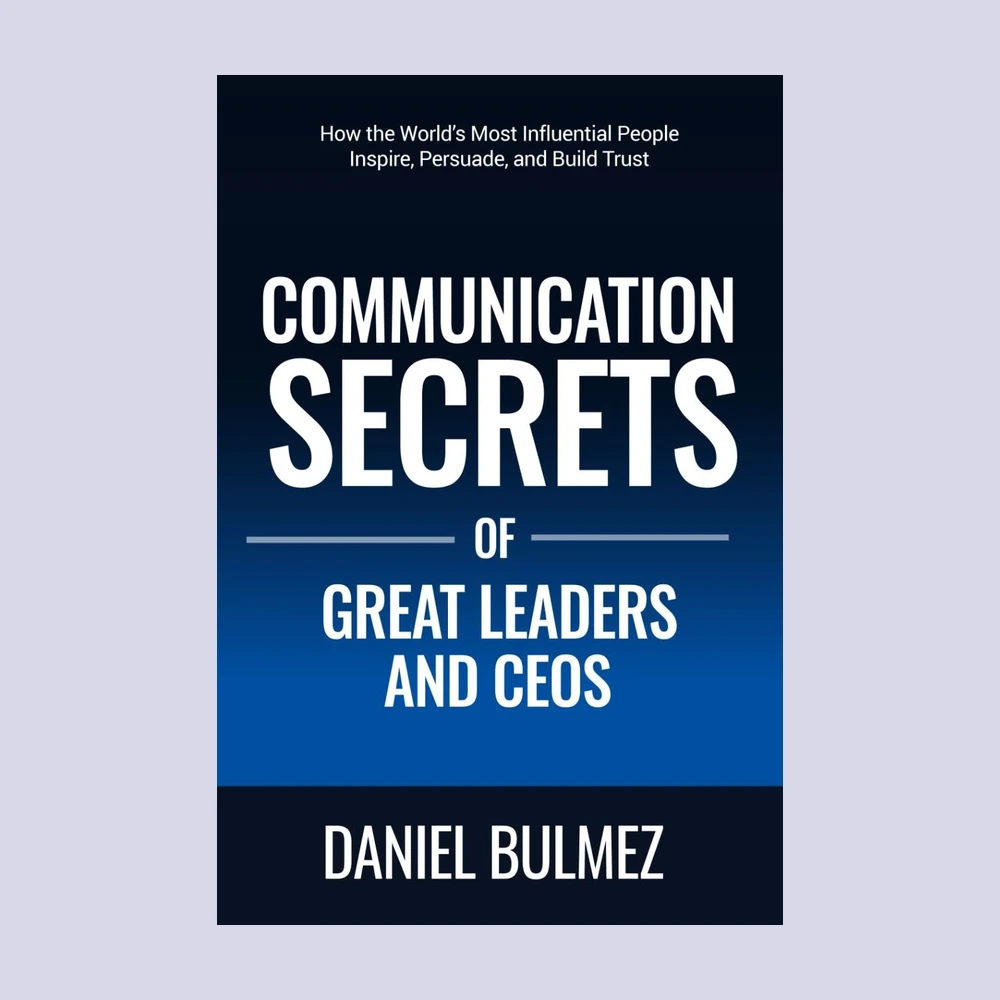
The leaders profiled in Communication Secrets of Great Leaders and CEOs all share one thing: they’re storytellers first, executives second. They’ve figured out that the spreadsheet doesn’t sell the strategy — the story does. The book breaks down how they do it in real rooms, with real stakes, line by line.
Storytelling for business isn’t about being charming. It’s about being understood — and understood in a way that moves people to act. Get that craft right and your ideas stop dying in slide decks. They start traveling.
Daniel Bulmez is the author of Communication Secrets of Great Leaders and CEOs, available on Amazon.