Books Like The Big Book of Why (TIME for Kids)
8 books like The Big Book of Why for kids who ask why all day - from National Geographic Kids to Smart Kids Ask Why, picked and tested at home.
 Daniel
September 10, 2026
4 min read
1 view
Daniel
September 10, 2026
4 min read
1 view

If your kid has read The Big Book of Why until the spine cracked, you already know why it works: it never makes them wait for chapter three. They ask “why do feet smell” and get an answer in about ten seconds flat. That instant hit — question in, answer out, on to the next one — is the whole engine of the book, and it’s the same engine behind every title on this list, including two Smart Kids Ask Why books that took the same one-question-per-page idea and gave it a bigger illustration budget.
Here are eight books built on that same instant-answer format, picked from a household that has tested all of them on kids who ask “why” more than they eat.
1. Smart Kids Ask Why: The History of the World
Most “big book of facts” collections jump around topics with no thread holding them together. This one picks a single thread — the story of everything that ever happened — and turns it into 101 full-color pages, 17 chapters, one big moment per page: a full-page illustration, four bite-sized facts, and a fun fact that usually surprises the grown-up reading along. A recurring kid-explorer character asks the same questions your child would, which is the detail that makes it read less like a reference book and more like a conversation. Best for ages 7 and up.

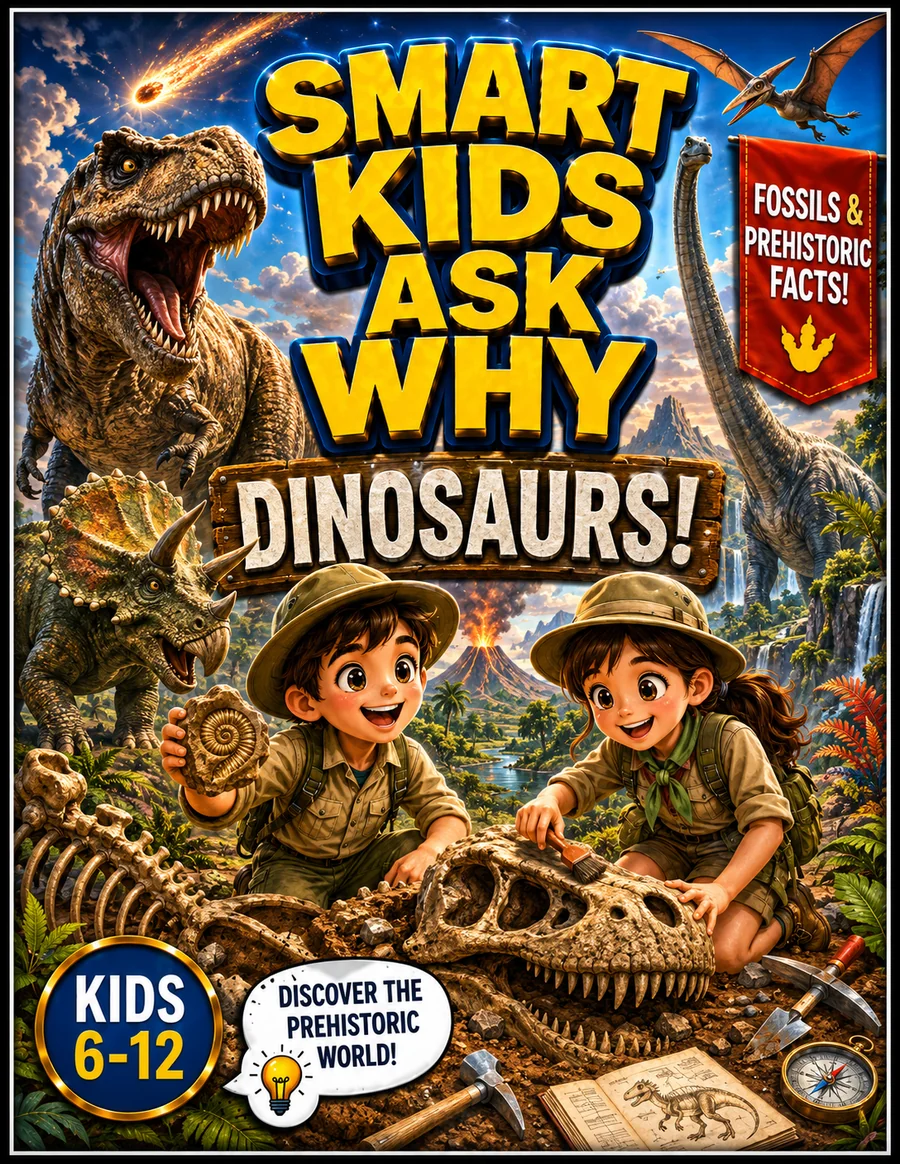
2. Smart Kids Ask Why: Dinosaurs!
For the kid who has moved on from “why” questions about the world and now only wants “why” questions about dinosaurs, this is the deep end: 112 full-color pages, and — true to the Big Book of Why format — every single page starts with a “why.” Profile-card spreads cover roughly twenty famous dinosaurs, including T. rex and Giganotosaurus, the predator that gives T. rex a real run for its title. Short answers, big pictures, built to survive a hundred rereads.
3. Why? Over 1,111 Answers to Everything (National Geographic Kids)
The heavyweight option. Real photography instead of illustrations, a huge topic spread, and enough entries that it survives years of bedtime browsing without repeating itself. It works best as a dip-in book you flip open at random rather than one you read cover to cover — some of the longer answers run a little wordy for younger readers — but for sheer volume of “why” questions answered, it’s hard to beat.
4. Weird But True! (National Geographic Kids)
Not strictly question-and-answer, but it scratches the exact same itch: one punchy, surprising fact per entry, arranged so a kid can flip anywhere and land on something worth reading aloud at dinner. The National Geographic Kids team has published enough volumes in this series that a curious kid can work through several before it stops feeling new, which is rare for this genre.
5. Tell Me Why, by Arkady Leokum
The book that arguably started this whole category — generations of curious kids grew up on it before The Big Book of Why existed. It’s text-heavier and mostly black-and-white, so it suits a strong reader (roughly 9 and up) better than a picture-book kid, but the answers go a little deeper than most modern Q&A books bother to.
6. 5,000 Awesome Facts (About Everything!) (National Geographic Kids)
If your kid’s actual complaint about The Big Book of Why is “I want more,” this is the answer — a fact-per-photo format with enough entries to make it feel bottomless. It trades the tight one-question focus for sheer breadth, so it’s less a book you read start to finish and more one you leave on the coffee table for a year.
7. Ripley’s Believe It or Not! Special Edition
Ripley’s leans stranger and more visual than The Big Book of Why — it’s built around “you won’t believe this is real” more than “here’s why this happens” — but the bite-sized, one-fact-per-spread structure and the browse-anywhere design are close cousins. It’s a good pick for a kid who likes the format but wants weirder subject matter than straight science.
8. Usborne Lift-the-Flap Questions and Answers
For the younger end of this age range (roughly 4-7), Usborne turns the same instant-answer idea into a physical game — the question sits on a flap, the answer waits underneath. It’s a smart format for a kid who isn’t reading fluently yet but already asks “why” all day, and the series covers everything from the human body to space to how machines work.
How to Pick
If your kid genuinely loved the format of The Big Book of Why — short, punchy, one question at a time — start with Smart Kids Ask Why: The History of the World or Dinosaurs!, since both keep that exact rhythm but commit to a single subject long enough to actually teach it, instead of skipping topics every page. For a kid who wants sheer volume over depth, Why? Over 1,111 Answers to Everything or 5,000 Awesome Facts will outlast almost anything else on a shelf. And if your reader still can’t sit through a paragraph, Usborne’s lift-the-flap format turns the same curiosity into something they can play with hands-on.
Whichever one you start with, the goal is the same one The Big Book of Why already proved works: never make a curious kid wait for the answer.
If you want more of this exact instant-answer format, our books like 100,000 Whys roundup has eight more picks in the same style.
Daniel Bulmez is the author of the Smart Kids Ask Why book series, available on this store and on Amazon.