Books Like National Geographic Kids “Why?” for Endlessly Curious Kids
Love National Geographic Kids Why? Here are 8 more question-and-answer and fact books that feed the same nonstop curiosity, kid-tested and picked by an author.
 Daniel
August 6, 2026
4 min read
21 views
Daniel
August 6, 2026
4 min read
21 views

If your kid has read National Geographic Kids Why?: Over 1,111 Answers to Everything cover to cover — twice — you already know what makes it work. It’s not a story. It’s a machine for answering the exact question a curious kid asks fifty times a day: “but why?”
That format — short, punchy, real answers instead of a slow-building narrative — is rare, and once a kid locks onto it, regular chapter books can feel painfully slow by comparison. The good news is Why? isn’t the only book built this way. Here are eight more that scratch the same itch, from full-color explorer-style guides to the classics that started the whole genre.
1. Smart Kids Ask Why: The History of the World
Most history books for kids either drown them in dates or oversimplify an entire era into one flat paragraph. Smart Kids Ask Why: The History of the World splits the difference: 17 chapters and 101 full-color pages moving from ice-age campfires all the way to the moon landing, with one big moment per page — a full-page illustration, four bite-sized facts, and a fun fact. A recurring kid explorer guides the way, asking the same questions your child would. It’s built for exactly the reader who loved Why?‘s format but wants it applied to the whole sweep of human history. Best for ages 7 and up.

2. Smart Kids Ask Why: Dinosaurs!
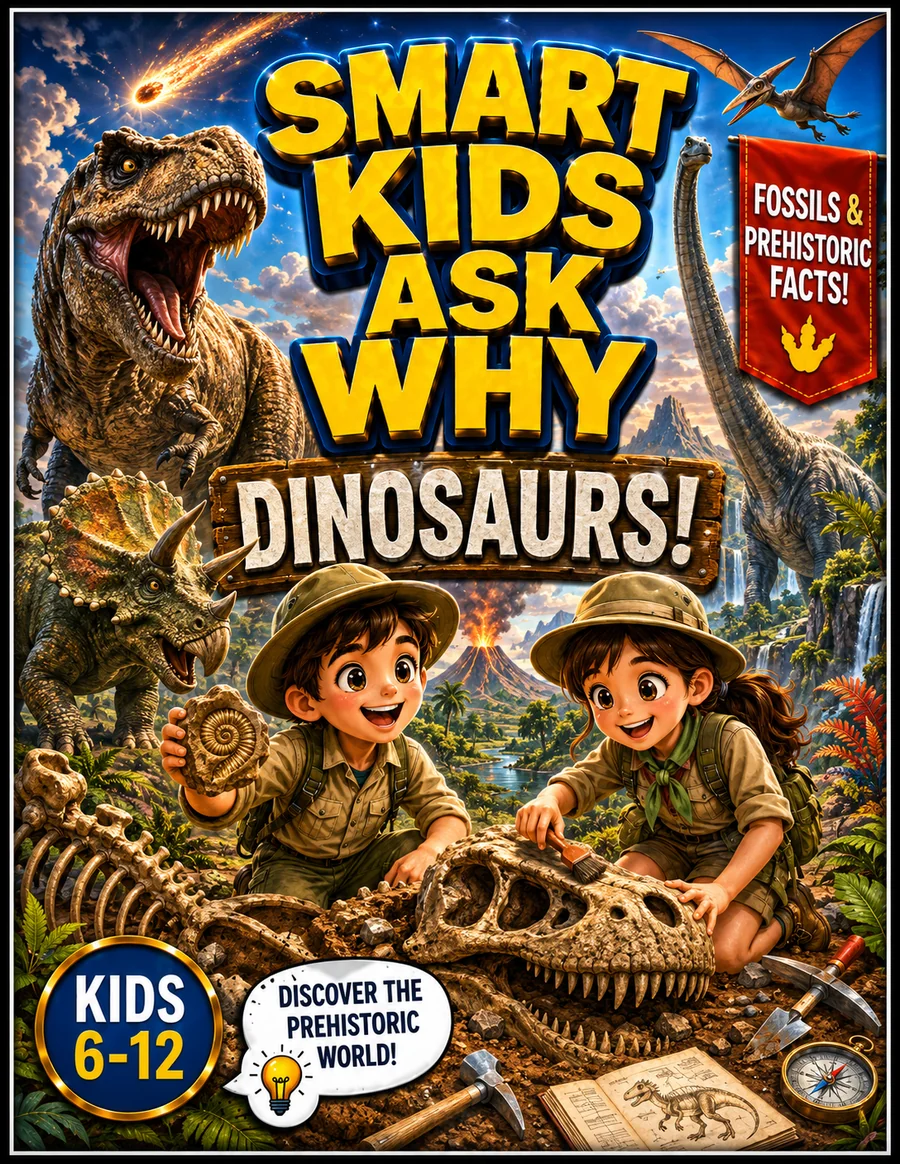
If your child’s current obsession is dinosaurs specifically, this is the deep end of the pool: 112 full-color pages where every single page starts with a “why,” covering what dinosaurs were, how scientists actually know what they know, and why they disappeared. Profile-card spreads dig into roughly 20 famous dinosaurs, including T. rex and Giganotosaurus — a genuine fan-favorite matchup for kids who like settling “who would win” debates. It’s structured exactly like the question-and-answer format that made Why? stick, just aimed squarely at one topic instead of everything at once.
3. National Geographic Kids Weird But True!
Same publisher, same photography-first style, different angle: instead of question-and-answer, Weird But True! is a rapid-fire feed of standalone, genuinely bizarre facts — one or two per page, paired with the same bright National Geographic photography kids already recognize. It’s less “why” and more “wait, WHAT,” which makes it a natural next book for a kid who has already worn out their copy of Why? and wants more from the same shelf.
4. National Geographic Kids Almanac
For a kid who wants volume, the annual Almanac is the biggest step up from Why? — hundreds of pages spanning animals, geography, science, and pop culture, updated year to year, all in the same fact-dense, photo-heavy style. It’s less a book you read start to finish and more one you keep on the shelf and dip into for years, which is exactly how most kids already treat Why?.
5. The Big Book of Why (TIME for Kids)
A classic for a reason, and about as close a format match to Why? as exists outside National Geographic. Punchy, single-page answers to the exact questions kids actually ask — “why do I get brain freeze,” “why do onions make you cry” — organized loosely enough that kids can flip around instead of reading in order. The design reads a little more old-school than National Geographic’s, but the question selection is still excellent.
6. Tell Me Why by Arkady Leokum
The book that arguably started this entire genre — generations of curious kids grew up on it long before Why? existed. It’s text-heavier and mostly black-and-white, so it suits a strong, older reader (roughly 9+) rather than a picture-browser, but the DNA is identical: real questions, straight answers, no filler.
7. Usborne Lift-the-Flap Questions and Answers
For the younger end of the curious-kid spectrum — around ages 4 to 7 — Usborne turns the Q&A format into a physical game: the question sits on a flap, the answer is underneath. It’s a genius bridge for a kid who isn’t reading fluently yet but already has the same relentless “why” energy that powers Why?. The series spans everything from the human body to space to how machines work.
8. Ripley’s Believe It or Not!
Less “why,” more “you won’t believe this” — but it fills the same shelf. Ripley’s has been collecting the world’s strangest true facts and stories for decades, and the bite-sized, one-oddity-per-page format is easy for the same reader who loves grazing through Why? rather than committing to a full chapter.
How to Pick
If your kid loves the specific question-and-answer rhythm of Why?, start with The Big Book of Why or Tell Me Why — they’re the closest format match. If they’ve simply exhausted every fact National Geographic Kids has to offer, Weird But True! and the Almanac are the obvious next stop. And if their curiosity has narrowed onto one subject — the whole span of human history, or dinosaurs specifically — that’s where Smart Kids Ask Why earns its shelf space: same fact-a-page, kid-driven format, built around a single big story instead of a grab bag of trivia.
Whichever you pick, the goal is the same one Why? already nailed: keep answering the question before the kid loses interest in asking it.
Daniel Bulmez is the author of the Smart Kids Ask Why book series, available on this store and on Amazon.