Executive Presence: What It Actually Is and How to Build It
Executive presence is not a personality trait. It is a set of observable communication behaviors — here is what they are and how to build them.
 Daniel
July 22, 2026
4 min read
16 views
Daniel
July 22, 2026
4 min read
16 views

Two people say the exact same thing in the same meeting. One gets nods and a follow-up question. The other gets talked over. Same content, same title, same seniority on paper — but only one of them read as someone who should be in charge. That gap has a name: executive presence. It’s the single most-cited reason capable people get passed over for promotion, and almost nobody can define it past “you know it when you see it.”
That vagueness is the problem. Executive presence isn’t charisma you’re born with or a look you can buy with a better blazer. It’s a set of specific, learnable communication behaviors — how you speak, how you carry silence, how you handle pressure in real time. Break it into its parts and it stops being mysterious. It becomes trainable.
1. Presence Is Built in How You Handle Pause, Not How You Fill It
Most people treat silence as something to avoid — they rush to fill every gap with words, fillers, or over-explanation. People who read as senior do the opposite. They let a pause sit after a question, take a beat before answering, and never rush to defend themselves the moment they stop talking. The pause reads as control. Filling it instantly reads as anxiety.
2. Say Less, and Make the Less Land Harder
Executive presence correlates more with restraint than with eloquence. Junior communicators try to prove competence by saying everything they know. Senior communicators say the one sentence that matters and stop. In a room full of people talking, the person who speaks least — but with the most precision — is usually remembered as the smartest one there.
3. Match Your Tone to the Stakes, Not the Panic in the Room
When something goes wrong, most people’s voice speeds up, rises in pitch, and gets louder. The person with executive presence does the opposite under exactly the same pressure — voice drops, pace slows, volume steadies. That vocal steadiness is read, correctly, as a signal that the situation is under control, even when it isn’t yet.
4. Take Up the Space You’ve Actually Earned
Posture, eye contact, and physical stillness are communication, not decoration. Shrinking — crossed arms, eyes down, edging toward the wall — reads as uncertainty regardless of what’s coming out of your mouth. This isn’t about performing dominance. It’s about occupying the space your title and your preparation have already earned, instead of apologizing for being in the room.
5. Answer the Question That Was Actually Asked
Under pressure, most people answer the question they wish they’d been asked, or bury the real answer in three paragraphs of context. Executive presence sounds like directness: answer the actual question first, in one sentence, then add context if it’s wanted. “Yes, we’ll hit the date” before the explanation of how — not after.
6. Own the Bad News Before Anyone Else Frames It
Nothing builds credibility faster than being the first person to say “this went wrong, here’s why, here’s the fix.” People with executive presence deliver bad news directly and early, without softening it into vagueness or waiting for someone else to surface it first. The instinct to hide bad news until it’s unavoidable is the single fastest way to lose the room’s trust.
7. Ask Questions That Show You’ve Already Thought Two Steps Ahead
The questions you ask in a meeting say more about your level than the statements you make. “What’s our fallback if the vendor slips?” signals someone already thinking about second-order consequences. “What does this mean?” signals someone still catching up. Executive presence shows up in the quality of the questions as much as the quality of the answers.
Why Executive Presence Is a Skill, Not a Trait
The mistake almost everyone makes is treating executive presence as something you either have or don’t — an innate quality some people are lucky enough to be born with. It isn’t. It’s a stack of specific, observable communication choices: what you say, what you don’t say, how you sound under pressure, and how you occupy a room. Every one of those choices can be practiced deliberately, which means the gap between “reads as junior” and “reads as the next VP” is closer than it feels.
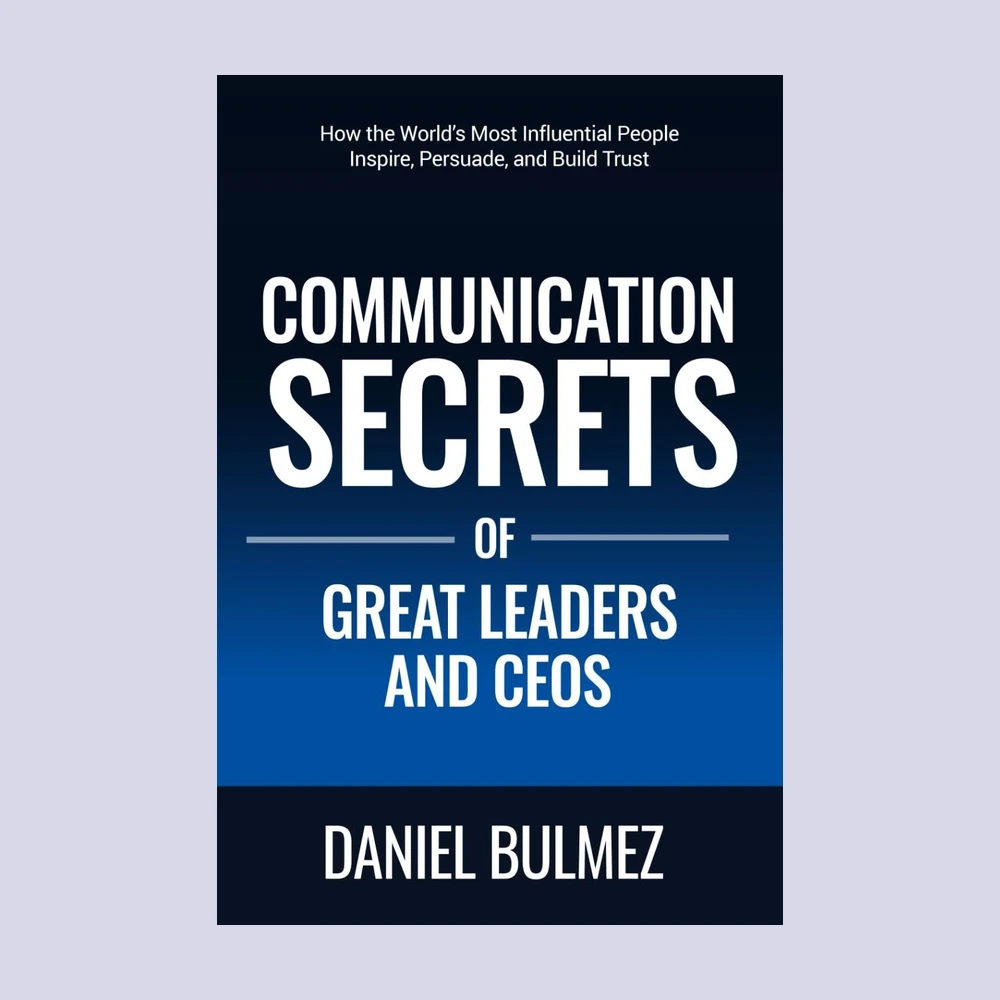
Communication Secrets of Great Leaders and CEOs breaks down the exact verbal and non-verbal patterns that read as “this person should be in charge” — the ones covered here, and the ones that only show up once you’re watching for them. If you want the full field manual instead of the highlight reel, Communication Secrets of Great Leaders and CEOs lays it out pattern by pattern.
Daniel Bulmez is the author of Communication Secrets of Great Leaders and CEOs, available on Amazon.